
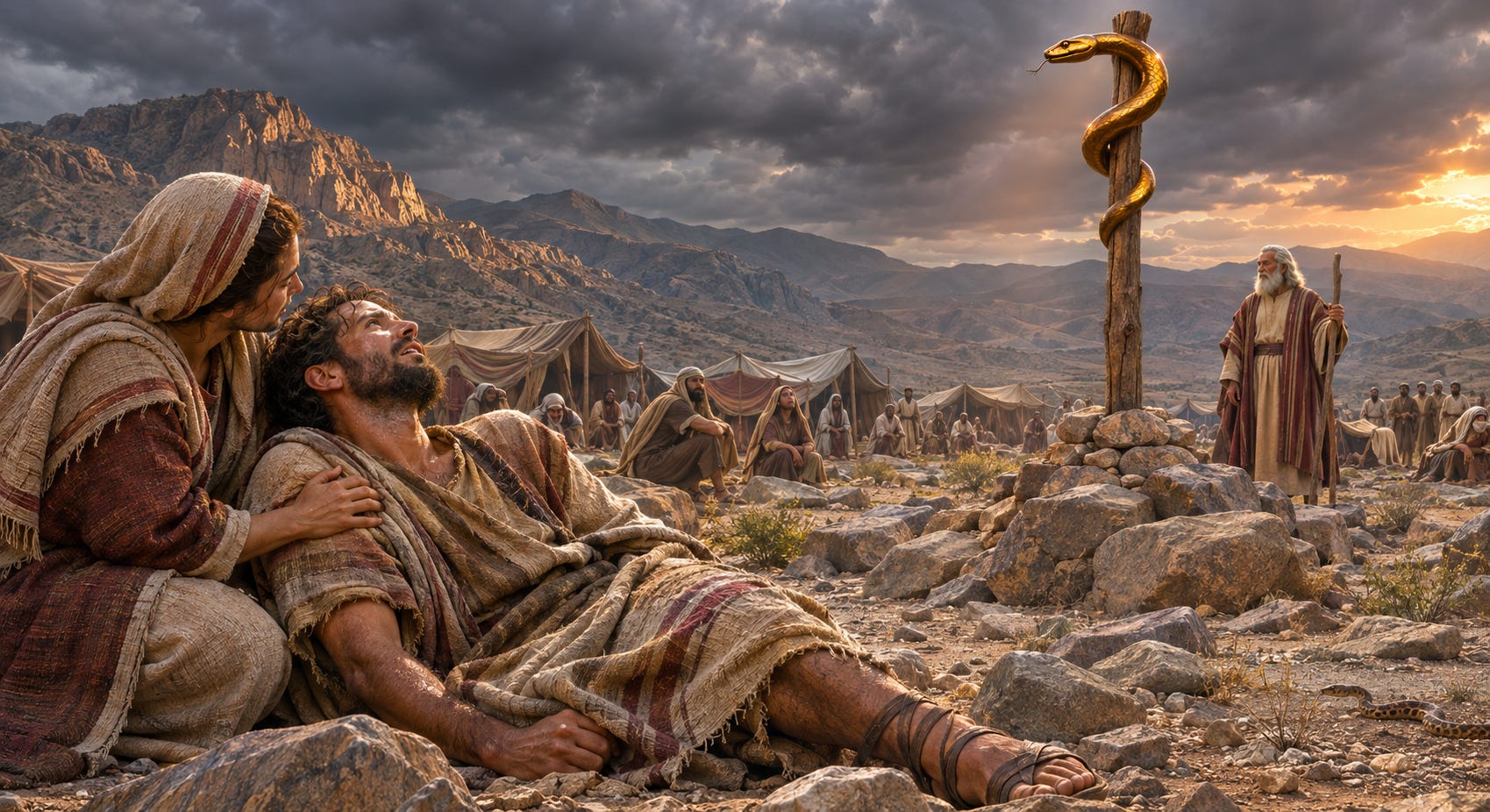
The people were tired of the journey, and they had grown tired of the bread that sustained them.
As Israel traveled around the land of Edom, discouragement turned into words against God and Moses. Why had they been brought out of Egypt to die in the wilderness? They complained of having no bread or water, then spoke with contempt of the food God had given them.
Their provision had become something to resent.
The Lord sent fiery serpents among the people. They bit the Israelites, and many died. The complaint against God had brought them face to face with His judgment.
Humbled, the people came to Moses and admitted their wrong.
“We have sinned,” they said, acknowledging that they had spoken against the Lord and against him. They asked Moses to pray that God would take the serpents away.
Moses prayed for the people.
The Lord answered with an instruction. Moses was to make a fiery serpent and set it upon a pole. Everyone who had been bitten could look upon it and live.
Moses made the serpent of brass and raised it as God commanded. When a bitten person looked at it, he lived.
The likeness of what had brought death now stood at the place God had appointed for rescue.
The brass had no life to give. Moses had not discovered a property in metal that could cure a snakebite. God had spoken, and the promise belonged to Him.
The people had not devised this remedy. Until God gave the instruction, they had no reason to expect that looking at a brass serpent would save them. He supplied the means and told them how to respond.
They could trust His word and look. Refusing to look would not make another remedy appear. Their freedom to choose did not give them authority to decide what would save them.
Looking was the act of faith. The life they received came from God.
There is an echo here of an older scene.
Humanity had once lived in a garden. After disobedience came life outside Eden, with toil and death ahead. Yet within God’s judgment stood His promise concerning the woman’s Seed: the serpent would wound Him, but He would bruise the serpent’s head.
Humanity could not invent its way back to life. Hope rested upon the deliverance God had promised.
Now, in the wilderness, another people faced death after speaking against Him. Again, God placed His provision before those who needed mercy. They had a word to believe and a response to make.
The resemblance reaches beyond what we might notice for ourselves. Centuries later, Jesus expressly connected the raised serpent with His own saving work.
Speaking to Nicodemus, He said that as Moses lifted up the serpent in the wilderness, the Son of man must be lifted up, so that whoever believed in Him would have eternal life.
The wilderness scene pointed toward the Savior.
Death had come through the flesh of Adam. Jesus Christ came in the flesh to bear our sins, give His life, and rise again. The promised deliverance entered human history in the person of the One God had sent.
Those awaiting Him trusted God’s revealed promises. We look back upon the Savior who fulfilled them. The rescue rests upon Him.
Our believing did not bring that rescue into existence. Christ did not wait for us to devise a way to be forgiven. He accomplished what we could never supply and calls us to receive His saving grace through faith.
The bitten Israelite could not boast that his glance had created life. He had trusted the One who promised it.
Neither can we make our faith another payment toward salvation. Faith receives what Christ purchased. It answers the mercy God initiated.
That response matters. We can trust His provision or turn elsewhere, but our freedom does not make every object of trust a savior. Wanting another answer cannot give it the power to save.
God has provided His Son.
The wilderness instruction was simple because the provision was already His. No elaborate ritual or exhausting effort could earn what He promised to give. They were called to believe Him, look, and live.
Their hope was never in the strength of their gaze.
It was in the faithfulness of the One who told them where to look.
“And as Moses lifted up the serpent in the wilderness, even so must the Son of man be lifted up: That whosoever believeth in him should not perish, but have eternal life.” —John 3:14–15
—Jeff Wager
#WagerEssays #TheEssayDepot #WhatGodSays #Apologetics #Theology