
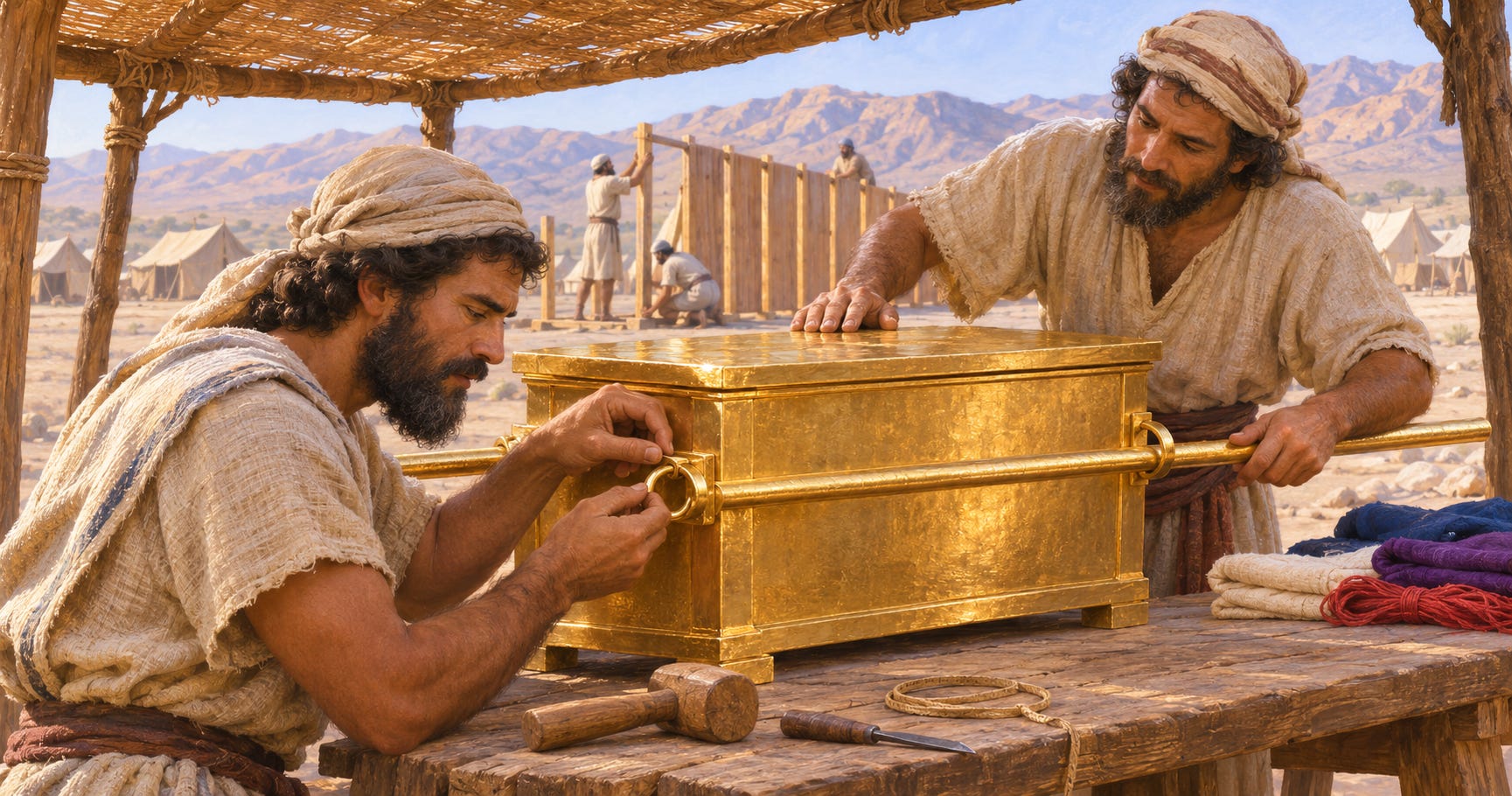
The craftsmen had an unusual problem. They had enough material to finish the work, and the people kept bringing more. Morning after morning, offerings arrived for the sanctuary until the men left their work and went to Moses.
“The people bring much more than enough for the service of the work, which the LORD commanded to make.”
Moses sent word throughout the camp that the people should bring no more. There was enough for everything God had commanded, with material to spare. The offerings could stop coming. The craftsmen had work to finish.
Before those materials had passed into their hands, Moses had announced whom God had chosen to lead the work. “See, the LORD hath called by name Bezaleel,” he told Israel. God had filled him with His Spirit, giving him wisdom, understanding, knowledge, and skill. Gold, silver, bronze, carved wood, and carefully set stones would take shape beneath hands God had equipped for His service.
Oholiab would share the work, and both men had also been given the ability to teach. The sanctuary would require more hands than theirs. Moses called the skilled workers whose hearts stirred them to come, and they received the offerings Israel had brought.
The giving and the making belonged to the same work. One person brought material another could use. One worker possessed a skill he could teach someone else. God had supplied the wisdom, and His instructions brought their different abilities together around a common purpose.
Bezalel made the ark from acacia wood and covered it with gold inside and out. He cast its rings and prepared the poles by which it would be carried. Above it, the mercy seat took shape in pure gold, with two cherubim beaten from the same piece, their wings spread over it and their faces turned toward it.
Its beauty belonged within the purpose God had given it. The measurements and arrangement came from His instructions to Moses, and Bezalel’s skill carried those instructions into something the people could see. Careful workmanship and obedience met in the same piece of gold.
That same care extended through the sanctuary. Curtains were made and joined. Boards, bars, pillars, and sockets were prepared for their places. The lampstand, table, altars, and priestly garments each belonged within a design the workers had received rather than invented.
There was room for all the skill God had given them. Following His instructions called upon their understanding, their attention, and their willingness to work. Their abilities found expression in making faithfully what He had entrusted to their hands.
Eventually, the workers brought the finished pieces to Moses. The materials once carried into the camp as offerings now stood before him as the tent, its furnishings, its vessels, and the garments for those who would serve within it. He examined the work and found that they had done what the Lord commanded.
Moses blessed them.
The completed pieces were ready to become the sanctuary. Moses raised the tabernacle according to God’s instructions, setting the boards and coverings in place. He brought the ark inside and hung the veil. The table stood ready, the lamps were lit, and the altar of incense took its appointed place. Around the sanctuary, he raised the court and hung its entrance.
Through the account, the words keep returning: as the Lord commanded Moses. The same direction that had guided the craftsmen now guided the setting of each piece. Their finished work belonged within the whole God had shown him.
Hebrews would later describe that earthly service as an example and shadow of heavenly things. It would recall God’s instruction to Moses to follow the pattern shown him, then direct its readers to Jesus Christ, the High Priest of a better covenant. The sanctuary’s meaning reached beyond the wilderness and beyond the lifetimes of the people making it.
Their hands were serving a purpose larger than they could hold.
When Moses finished the work, a cloud covered the tent of the congregation, and the glory of the Lord filled the tabernacle. Even Moses could not enter because the cloud rested upon it and God’s glory filled it.
The workers had brought their skill. The people had brought their offerings. What stood complete had passed through willing hands that followed what God had said. Now the sanctuary was filled with a glory none of those hands could make.
That presence would remain before Israel throughout their journeys. When the cloud rose, they traveled. When it remained, they stayed. By day the cloud rested upon the tabernacle; by night fire was upon it, in the sight of the whole house of Israel.
The work of their hands had become part of the life of the camp. Their children would see the cloud. Their families would wait beneath its direction. The sanctuary they had helped prepare stood among them as they followed the God who had brought them there.
They finished their work as they served the Lord.
“Then a cloud covered the tent of the congregation, and the glory of the LORD filled the tabernacle.” —Exodus 40:34
—Jeff Wager
#WagerEssays #TheEssayDepot #WhatGodSays #Apologetics #Theology