
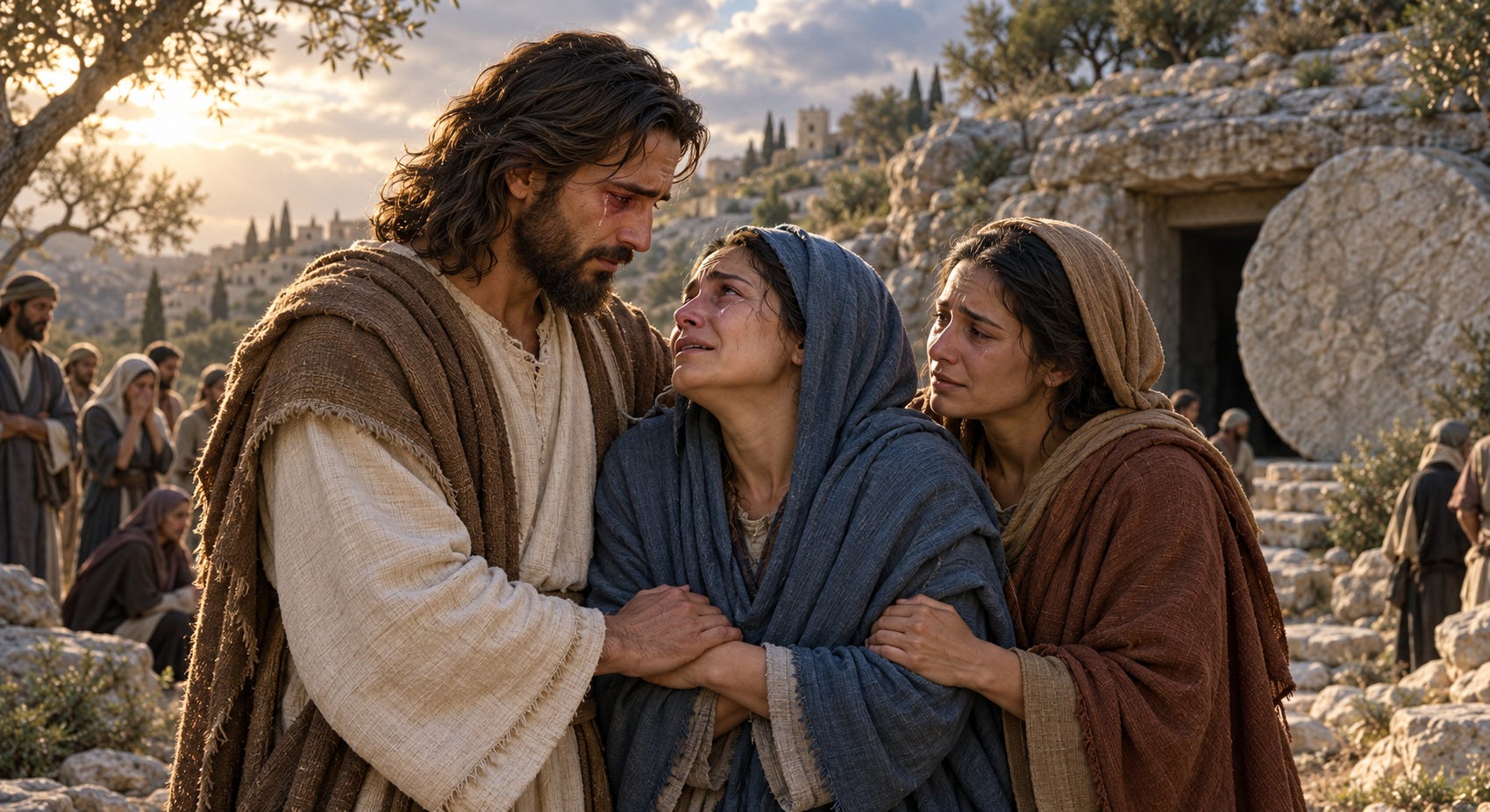
The objection looks upward from the wreckage and asks:
Where is God?
If He is sovereign, untouched by surprise, and secure upon His throne, does He merely watch suffering from a place where nothing can reach Him?
Human beings bleed, grieve, hunger, weaken, and die. God remains God. Does that make Him a distant ruler who writes painful laws for creatures while remaining safely insulated from everything those laws permit?
The question carries emotional force because detached power is frightening.
A king who sends starving soldiers into battle while feasting behind guarded walls may possess authority, but he has not earned their trust. A ruler who discusses suffering only as numbers on a page can easily forget that every number has a name.
If that were the Christian picture of God, the objection would strike deeply.
Christianity presents something very different.
The Word became flesh.
God the Son entered human history as Jesus Christ. He did not arrive wearing the appearance of humanity while secretly avoiding its weight. He experienced hunger, thirst, exhaustion, temptation, rejection, grief, betrayal, physical pain, and death.
He knew what it meant to be misunderstood by His family.
He knew what it meant to be abandoned by friends.
He knew the sting of false accusations, public humiliation, and violence carried out beneath the approval of religious and political power.
Jesus wept beside a grave even though He knew resurrection was moments away.
He did not stand before Mary and Martha explaining that their grief was a minor problem inside a larger plan.
He entered their sorrow.
That does not mean the Father became incarnate or that every distinction between the Father and the Son disappeared. The Son entered human flesh, yet Jesus was not merely an unrelated victim sent forward while God remained safely behind Him.
God was in Christ, reconciling the world unto Himself.
Jesus willingly laid down His life. The cross was not something forced upon an unwilling Son by a cruel Father. Christ knew what waited in Jerusalem and walked toward it.
God did not remain distant from the cost of human redemption.
He bore that cost through the Son.
This does not answer every question about why God permits particular suffering. The fact that Jesus suffered does not make abuse acceptable, disease pleasant, or bereavement easy. We should never point at the cross merely to silence someone who asks why a child died or why an innocent person was harmed.
The cross does not tell us the private reason behind every wound.
It tells us that God is not indifferent to wounds.
Christ’s suffering accomplished more than a demonstration of sympathy. Jesus did more than show that He understood pain. He carried sin, satisfied justice, opened the way to forgiveness, and defeated death through His resurrection.
He entered suffering in order to break its final claim.
That is where divine sovereignty and divine compassion meet. Jesus could have avoided arrest. He could have called for deliverance. He declared that no one took His life from Him; He laid it down willingly.
His suffering was real.
His authority remained intact.
Voluntary suffering is not helplessness. It is power choosing to bear a burden it could have refused.
The incarnation also changes how Christians should respond to other people’s pain. If Christ entered the suffering of humanity, His followers cannot claim to honor Him while remaining comfortably detached from the wounded.
We are commanded to visit the sick, feed the hungry, protect the vulnerable, mourn with those who mourn, and remember the imprisoned.
Compassion requires proximity.
It is easy to discuss pain from a safe chair. It is harder to sit beside someone whose grief cannot be repaired with a sentence. Christ did not love humanity from a distance, and His followers should not use theology as an excuse to do so.
Still, we must keep the responsibility for evil in its proper place. God’s willingness to redeem suffering does not make Him the moral author of the sins that caused it. Judas betrayed. Pilate yielded. Religious leaders accused. Soldiers struck and crucified.
Their choices were their own, yet none of them pushed God’s purpose off course.
The three pillars remain standing.
God is sovereign: Christ entered suffering willingly, and neither betrayal, violence, nor death could overthrow His saving purpose.
Human agency is bounded: people made genuine evil choices against Jesus, but they could not turn the cross into God’s defeat.
The verdict is settled: the cross reveals both God’s judgment against sin and the mercy offered through faith in Christ.
The throne of God is not threatened by human pain.
Neither is it deaf to it.
The King did not shout instructions toward suffering humanity from the far side of heaven.
He came near enough to carry scars.
“For we have not an high priest which cannot be touched with the feeling of our infirmities; but was in all points tempted like as we are, yet without sin.” —Hebrews 4:15
—Jeff Wager
#WagerEssays #TheEssayDepot #WhatGodSays #Apologetics #Theology