
The accusation reaches Samuel before the evidence does.
He has been reading John’s Gospel when he comes across the claim that the Bible was corrupted long ago. The claim suggests that the revelation Christians trust is no longer what God originally gave.
Samuel looks down at the open page. A moment earlier, he was considering what John said about Jesus. He doubts the accusation, but he is willing to examine it honestly. Confidence in Scripture gives him no reason to avoid checking a claim made against it.
He reaches for his computer. If the claim concerns a change in history, there ought to be something historical to examine. He wants more than the vague accusation that somebody, somewhere, must have altered something.
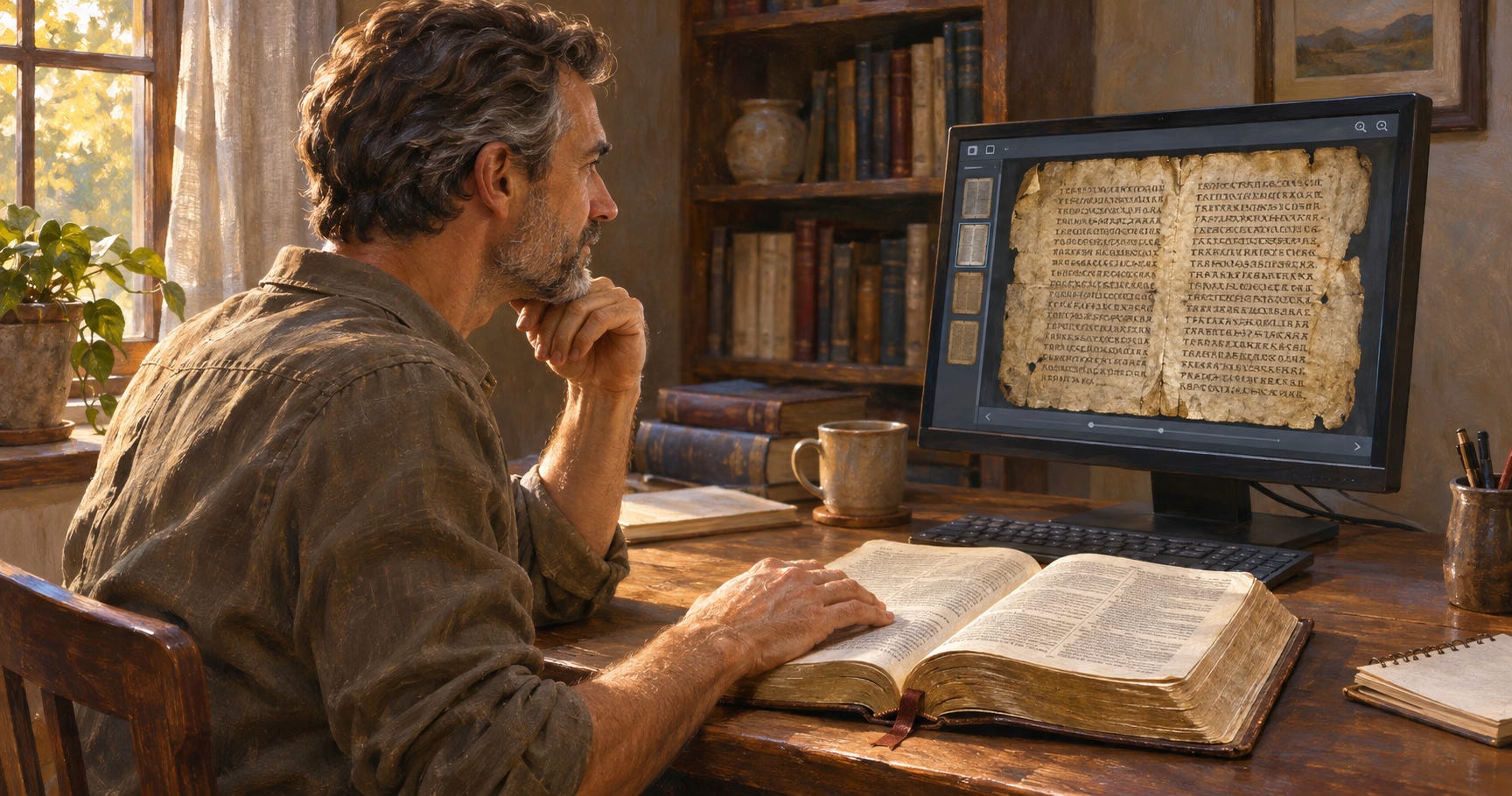
His search leads him to images of Codex Sinaiticus. The name is unfamiliar, but the manuscript project explains what he is looking at: a Christian Bible copied in the fourth century, containing the earliest surviving complete New Testament. He opens the photographed pages and studies the columns of Greek writing.
Samuel cannot read the ancient script unaided. The accompanying transcription and reference material help him find the passage that brought him here. John’s testimony about the Word being with God and being God is already on the old page. So is the account of the Word becoming flesh.
The teaching he was told to distrust existed centuries before Muhammad.
He sits back. The manuscript has not answered every question, but it has answered one. This testimony was not added after Islam began. The old page will have to be accounted for.
Samuel returns to the article. Its author, a Muslim critic who denies Christ’s divinity, has directed him toward several Quran passages. He follows the references, keeping the manuscript image open beside them.
The first takes him to a Jewish community already possessing the Torah. Quran 5:43 speaks of divine judgment within it. A little farther down, in 5:47, the People of the Gospel are directed to judge by what Allah revealed in it. Another reference, 10:94, directs the person addressed, if in doubt, to ask those reading the earlier Scripture.
Samuel reads that direction twice. These were people who could be consulted in the seventh century, with Scriptures available to read. The Quran speaks of the Torah in Jewish hands and directs the People of the Gospel to judge by the revelation within it. The Quran’s directions do more than acknowledge that earlier Scripture existed: they appeal to its truth. Those reading it are presented as people who can be consulted for confirmation, and its revealed teaching as a standard by which to judge.
He glances at the article’s accusation, then back at the references. The argument had made the earlier Scriptures sound useless. The Quran passages appeal to truth within those Scriptures as something people could rely upon.
Those claims cannot simply pass each other without explanation.
Samuel continues reading. The author points to accusations of distortion, and Samuel follows those too. In Quran 3:78, people twist their speech so listeners think something belongs to Scripture when it does not.
That sounds familiar. Samuel has heard a biblical verse stretched well beyond what it says. He has opened his Bible afterward, read the surrounding passage, and wondered how so much had been squeezed out of words that meant something else.
The speaker had mishandled the passage. Samuel had still been able to find the passage and read it.
He returns to John’s opening words. An accusation that someone misrepresented Scripture does not establish that its written testimony was replaced. The article needs to show how it crossed from one claim to the other.
On the screen beside it, the fourth-century manuscript remains open. Samuel now has the timeline clearly before him. John’s testimony about Jesus was already written centuries before the Quran directed people toward earlier Scripture. The teaching in his Bible today is present in that earlier witness.
He broadens his examination, comparing the early Greek manuscript witnesses and the published transcriptions available to him. Each preserves John’s statement that the Word was God. As far as Samuel can establish from those records, this is the testimony already present before Islam. His examination produces no evidence that the wording was introduced to replace a different statement.
He returns to the article looking for evidence that addresses what he has found. Which words supposedly replaced an earlier reading? What manuscript shows the claimed change? The accusation needs more than disagreement with what John says.
As he reads the manuscript project’s notes, Samuel finds corrections and differences being discussed openly. He slows down. He will not answer an exaggerated accusation with an exaggerated defense.
The books were copied by hand. Their surviving copies do not agree in every detail. Samuel examines what the project says about those differences rather than pretending they are absent.
A correction somewhere in a manuscript, however, cannot be made to prove that John’s testimony about Jesus was invented. That claim needs evidence concerning that testimony. He brings the passage back onto the screen, keeping the question attached to the words actually being disputed.
The testimony is still there.
Samuel reaches for his Bible and turns to Romans 3. Paul speaks of the Jews being entrusted with the oracles of God, then asks whether human unbelief can nullify God’s faithfulness. Samuel follows Paul’s answer. Human unfaithfulness does not make God unfaithful.
He remembers Moses placing the written Law into the care of Israel’s priests and elders. He finds the account in Deuteronomy 31 and reads the instructions for keeping it and reading it to the people. The next generation was to hear what God had given, not begin again with whatever its teachers preferred.
Samuel recognizes that people from any nation can bear witness to God’s truth. Bearing witness, however, does not give someone authority to replace the testimony. These passages entrust God’s oracles to the Jews and announce no later transfer of that responsibility to someone else. They provide no appointment of Muhammad—a non-Jew presented in Islamic tradition as a descendant of Ishmael—to repair a supposedly lost Bible.
In the article before Samuel, a Muslim critic who denies Christ’s divinity alleges that those entrusted with Scripture failed to preserve its testimony accurately. The allegation does not establish that God’s revelation disappeared. It does not establish authority for another religion to replace it.
He turns to Isaiah’s declaration that God’s Word stands forever, then to Jesus’ promise that His words will not pass away. These are the grounds of Samuel’s confidence in God’s faithfulness. The old manuscript gives him historical evidence to examine alongside that confidence.
He does not need every copyist to have been flawless for the testimony to have endured. He needs to examine the surviving witnesses honestly—and refuse to confuse their differences with proof that the Gospel was lost.
The article is still waiting on the screen. Its author denies that Jesus is God in the flesh. The passage beside Samuel identifies the Word as God and tells of His coming in the flesh. The disagreement is real.
Calling the later denial a restoration does not settle which testimony is true. It certainly does not demonstrate that the earlier testimony was altered. A teaching that denies Christ’s divinity corrupts the biblical message it claims to restore.
Samuel does not know whether the author knowingly misled anyone. Perhaps he repeated an argument he had never examined himself. Samuel can confront the teaching without pretending to know the man’s heart.
He also knows what his own examination has—and has not—established. The Quran references do not certify every reading in every biblical copy or explicitly endorse John’s declaration of Christ’s divinity. They do raise a difficulty for dismissing all earlier revelation as unavailable or untrustworthy. The manuscript evidence, meanwhile, places the particular testimony about Jesus before Islam.
Neither has made the Quran the authority over Samuel’s Bible.
Samuel closes the article but leaves the manuscript image open. He has found the earlier testimony for himself. The article’s disagreement with that testimony has supplied no evidence that someone changed it.
Samuel’s confidence settles as he looks again at John’s words. The early witnesses preserve the testimony before him, and the accusation has supplied no evidence that it was replaced. He receives what he is reading as truth and continues with greater confidence in the God whose Word endures.
Samuel had given the accusation a fair hearing, and he found no reason to place faith in this allegation against Scripture made by someone who denies the divinity of Jesus.
He would keep his faith.
“The grass withereth, the flower fadeth: but the word of our God shall stand for ever.” —Isaiah 40:8
—Jeff Wager
#WagerEssays #TheEssayDepot #WhatGodSays #Apologetics #Theology