
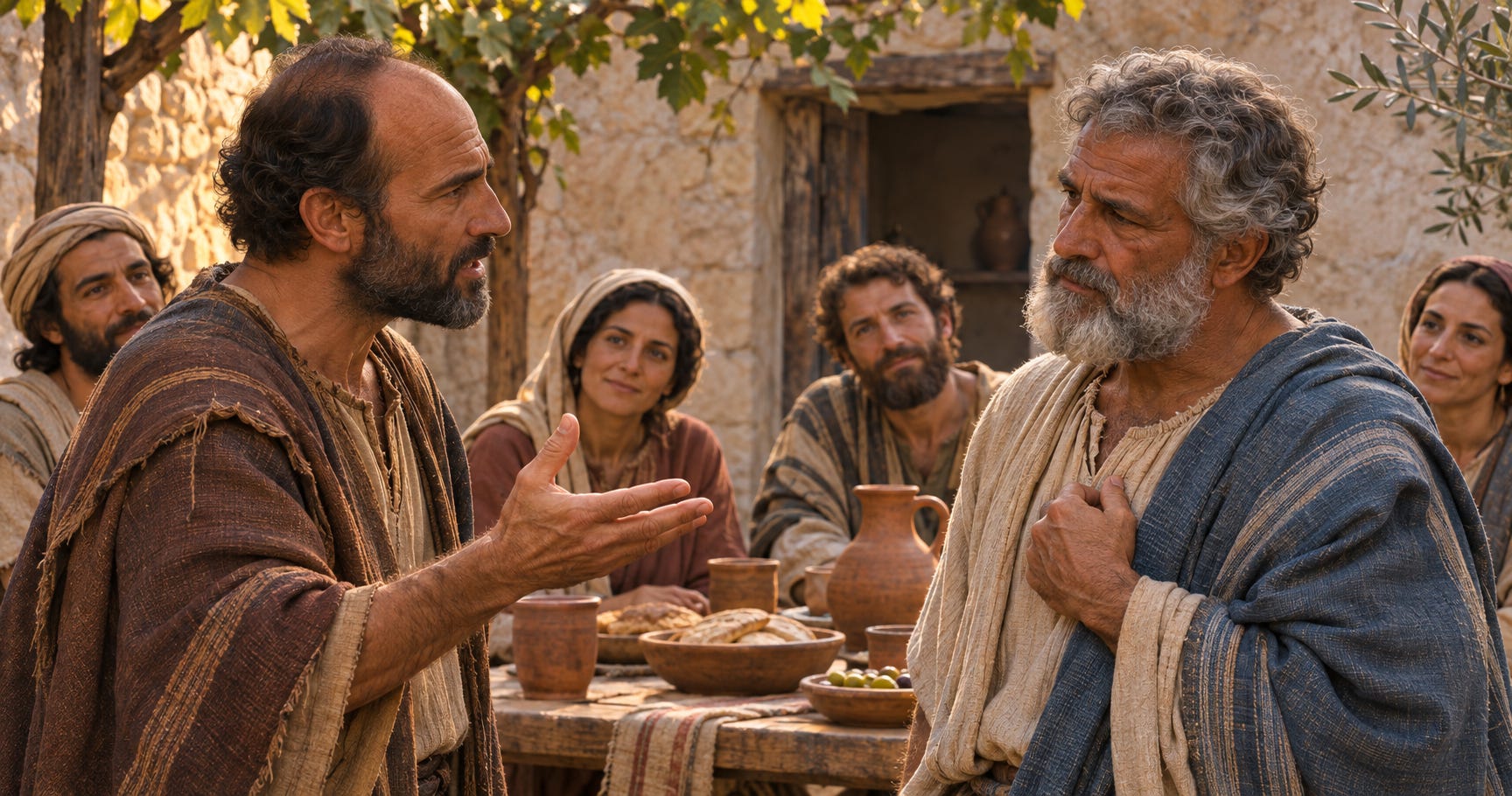
Peter had been eating with the Gentile believers in Antioch. Then certain men arrived from James, and Peter began withdrawing from the people whose table he had shared.
Their faith had not changed. Neither had the gospel. Peter was afraid of what the newcomers would think.
Other Jewish believers followed his example. Even Barnabas was carried along. One man’s fear was becoming a division among people Christ had received.
Paul saw what was happening and confronted Peter openly. “If thou, being a Jew, livest after the manner of Gentiles, and not as do the Jews, why compellest thou the Gentiles to live as do the Jews?”
This was Peter, the disciple who had walked with Jesus, denied Him, wept over his failure, and received His call to feed His sheep. The risen Savior had restored him to service. Now, while serving, Peter needed correction again.
The breakfast beside the sea had not been the last place where the Lord would have to work on him.
There was real harm in what Peter was doing. The Gentile believers were being treated differently, and others were learning to follow his example. Paul loved the truth too much to leave that alone. His rebuke brought Peter’s conduct back alongside the gospel he already believed.
Peter knew whose people they were. He needed to live accordingly.
Long before that disagreement in Antioch, another servant of God had needed someone to bring the truth directly to him.
Nathan came to David with a story about two men. One was rich, with many flocks and herds. The other had one little lamb, raised among his children and treated almost like a daughter. When a traveler arrived, the rich man spared his own animals and took the poor man’s lamb to prepare the meal.
David was furious. He could see the cruelty plainly when Nathan placed it in another man’s house. He declared that the offender deserved to die and must repay the lamb fourfold.
Nathan answered, “Thou art the man.”
God had sent him.
David had taken Uriah’s wife and arranged for Uriah to be killed. The king who had received so much from God had used his position to take what did not belong to him, then tried to cover the wrong with another wrong.
Nathan’s words brought the account home. David was no longer judging a stranger in a story. He was answering for himself.
“I have sinned against the LORD,” he said.
Nathan answered with mercy: “The LORD also hath put away thy sin; thou shalt not die.”
He also announced consequences. Forgiveness did not bring Uriah home or spare David’s household the grief ahead. God’s mercy reached a man whose choices had caused terrible harm, and that man would have to face what followed.
David’s response to God appears in Psalm 51. He asks for cleansing, a clean heart, and a right spirit. He asks God to restore the joy of His salvation.
The man who had tried to arrange events around his sin was now asking God to change him within.
His prayer reaches beyond relief. He wants to teach transgressors God’s ways. He wants his tongue to sing of God’s righteousness and his mouth to show forth His praise.
The lips confessing the wrong are asking to become useful in God’s service again.
David had belonged to God before Nathan arrived. Peter had belonged to Christ before Paul confronted him. Neither man’s relationship with God made his conduct harmless. In each account, God’s truth reached into the life of someone who already knew Him.
Their service and their need for correction existed at the same time.
That can be an uncomfortable thing to recognize. A person may sincerely love God and still hear words leave his mouth that he should have restrained. He may see an old fear directing a new decision, or discover that pride has found another respectable explanation for itself.
Sometimes he knows while he is doing it. Sometimes someone has to place the matter before him as plainly as Nathan did before David.
The correction can hurt. It reaches the place where the excuse had been sitting.
David could have kept defending himself. His authority had already helped him conceal what he had done. When God sent the truth through Nathan, however, David acknowledged it. His prayer began with a plea for mercy.
That plea had somewhere to go.
The Shepherd Peter followed had spoken of knowing His sheep, giving them eternal life, and keeping them in His hand. Their safety rested in Him. Their need to hear His voice continued throughout the life He gave them.
His care includes bringing their conduct into the light, teaching them through His Word, and sending someone who loves them enough to speak honestly.
The child receiving correction has something to learn. Belonging to the Father is the relationship within which that learning takes place.
Peter’s account carries that reality beyond Antioch. In his second letter, he refers to Paul as “our beloved brother Paul” and acknowledges the wisdom given to him.
The brother who had confronted him was still a beloved brother.
Peter’s letter does not give us a transcript of what happened after the rebuke at Antioch. It does give us an apostle continuing to serve, warning believers about error, and directing them toward growth.
He knew the Lord’s patience. He knew what it meant to need correction after years of following Him. His readers were people who needed to keep learning too.
He did not ask them to pretend they had reached the end of that work.
He told them to grow.
The grace that had received them would remain the grace in which they learned to walk. Their hope rested in Christ, and their lives remained in His hands as He shaped them.
Peter’s final words turn the attention toward the One who deserves the gratitude.
“But grow in grace, and in the knowledge of our Lord and Saviour Jesus Christ. To him be glory both now and for ever. Amen.” —2 Peter 3:18
—Jeff Wager
#WagerEssays #TheEssayDepot #WhatGodSays #Apologetics #Theology