
“Lord, I am ready to go with thee, both into prison, and to death.”
Peter had made his promise. Whatever waited beyond that evening, he intended to face it beside Jesus. The Lord had just warned him that Satan desired to sift the disciples as wheat, yet He had also given Peter something to hold onto: “I have prayed for thee, that thy faith fail not.” He spoke of Peter’s return and told him to strengthen his brothers. Peter answered by offering his courage.
Jesus answered with a warning about how soon that courage would fail.
“I tell thee, Peter, the cock shall not crow this day, before that thou shalt thrice deny that thou knowest me.”
Later, Peter went with Jesus and the other disciples to the Mount of Olives. The warning concerned the very night they were entering, and Jesus gave them something to do before the test arrived. “Pray that ye enter not into temptation,” He told them. Then He withdrew a short distance, knelt, and prayed.
When Jesus returned, He found them sleeping from sorrow. “Why sleep ye?” He asked. “Rise and pray, lest ye enter into temptation.” Peter had been ready to offer his life; now the Lord was calling him to rise and pray. The help he needed began with prayer. Jesus had given that instruction before anyone in a courtyard asked whether Peter knew Him.
While Jesus was still speaking, a crowd approached with Judas leading the way. One of their own had brought the company that would take Him away. Judas drew near to kiss Him, and Jesus asked, “Judas, betrayest thou the Son of man with a kiss?” Jesus was being taken away, and Peter would soon face the very test he had been certain he could endure.
The men arrested Jesus and led Him to the high priest’s house. Peter followed at a distance. When they reached the courtyard, he sat among the people gathered around a fire, close enough that a servant girl could study his face. “This man was also with him,” she said. Peter had promised to stand beside Jesus even in prison. Now, seated beside a fire, he answered, “Woman, I know him not.”
A little later, someone else recognized him. “Thou art also of them,” the man said. Peter answered, “Man, I am not.”
About an hour passed before another person insisted that he had been with Jesus, pointing out that he was a Galilaean. “Man, I know not what thou sayest,” Peter replied.
While he was still speaking, the rooster crowed.
The Lord turned and looked at Peter. He remembered the warning, and the promise he had made stood against the words he had just spoken. He went outside and wept bitterly.
There is something painfully familiar about a promise remembered after we have broken it. We meant it when we said it. We knew what was right. Then pressure came, and the words leaving our mouths belonged to someone we had been certain we would never become. Peter’s grief needs little explanation to anyone who has disappointed someone he loves.
He could not call those denials back. They belonged to his story now, alongside the years he had spent following Jesus. His failure had been real, and the Lord had known it was coming. That same knowledge stood behind the other words Jesus had spoken: He had prayed for Peter and had work for him beyond his return.
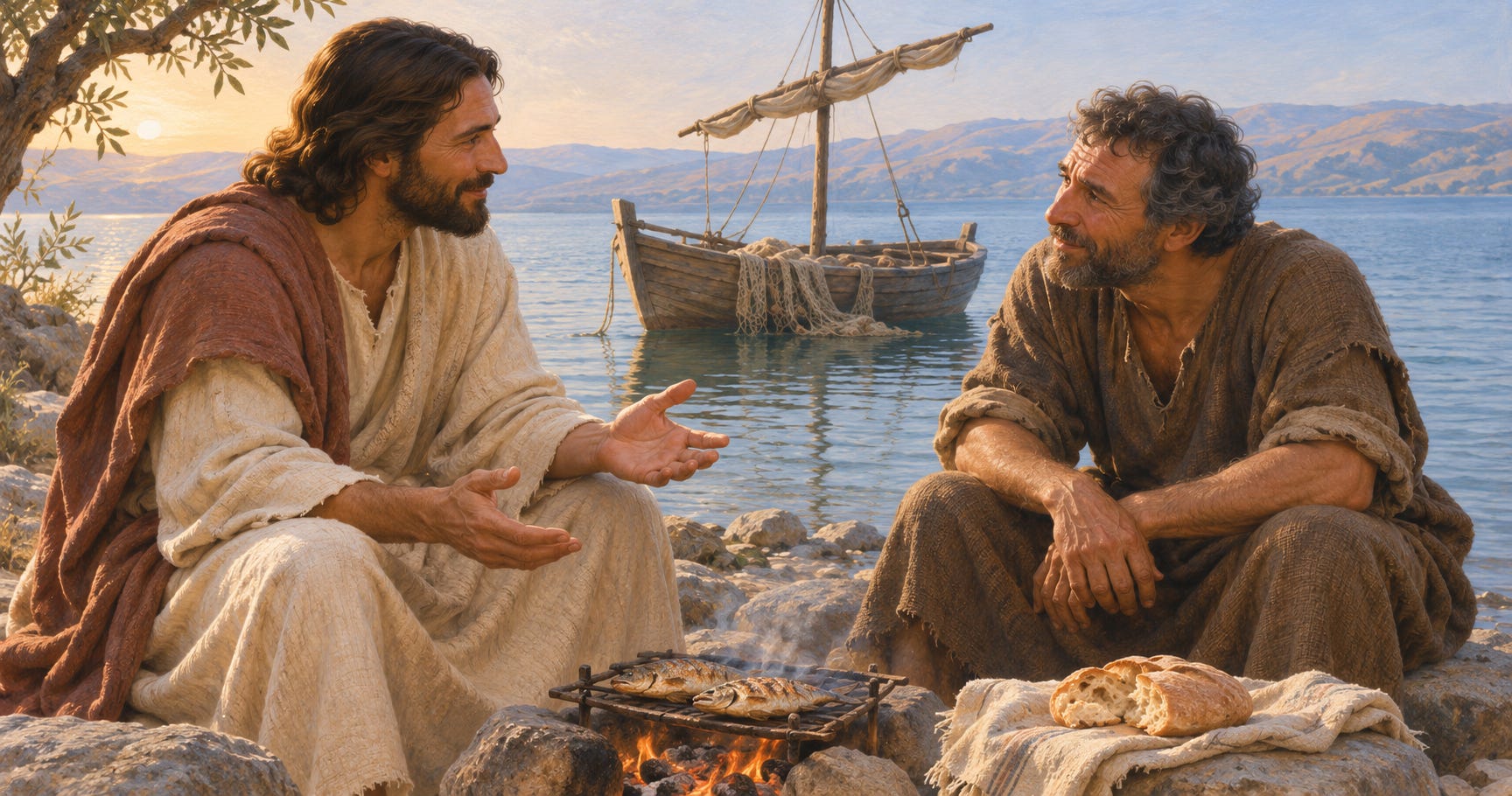
After the resurrection, Jesus met His disciples beside the sea. When they came ashore, they found a fire of coals with fish laid upon it and some bread. “Come and dine,” He told them. He gave them bread and fish, and Peter was there to receive it. The Lord who had heard his denials was now serving him breakfast.
Peter had a place at that meal, yet his story with Jesus reached beyond being welcomed ashore. Before his failure, the Lord had told him to strengthen his brothers when he returned. Now Jesus would give him that responsibility in words Peter could carry with him. The man who had denied knowing Him would be called to care for those who belonged to Him.
After the meal, Jesus turned to Peter with a question: “Simon, son of Jonas, lovest thou me more than these?” Three times He asked whether Peter loved Him, and each answer brought a charge to tend His flock. By the third question, Peter was grieved. “Lord, thou knowest all things,” he answered. “Thou knowest that I love thee.” Jesus told him, “Feed my sheep.”
Peter had offered a great promise before the courtyard. Here beside the sea, he brought his love before the One who knew everything. Jesus knew the denials. He knew the tears. He had known both were coming when He told Peter to strengthen his brothers after his return. That failure had never been outside the reach of His knowledge or His care. Now Peter stood before Him with no brave speech to offer, and the Lord still had sheep for him to tend.
That calling would take Peter beyond the comfort of the shore. Jesus spoke of his old age, when another would lead him where he did not wish to go. John tells us He was describing the death by which Peter would glorify God. Then Jesus said, “Follow me.”
The invitation had not become easier, but Peter had been shown how much he needed the Savior who gave it. His own confidence had failed him. He could no longer mistake a brave promise for the strength to keep it. Christ’s knowledge, prayer, and care had held through the very night that exposed his weakness.
There were still choices ahead, people to strengthen, and sheep to tend. Forgiveness had not made Peter’s conduct unimportant. Mercy had brought him back to a life in which following Jesus mattered more deeply than another confident speech about what he could manage on his own.
He had once promised to follow Jesus even to death. Now the risen Lord had spoken of the death that lay ahead and called him to follow again. Peter stood before Him with his failure known, his love confessed, and a place in His service. To walk that road, he would need to trust the Lord more than his own promises.
“But I have prayed for thee, that thy faith fail not: and when thou art converted, strengthen thy brethren.” —Luke 22:32
—Jeff Wager
#WagerEssays #TheEssayDepot #WhatGodSays #Apologetics #Theology