
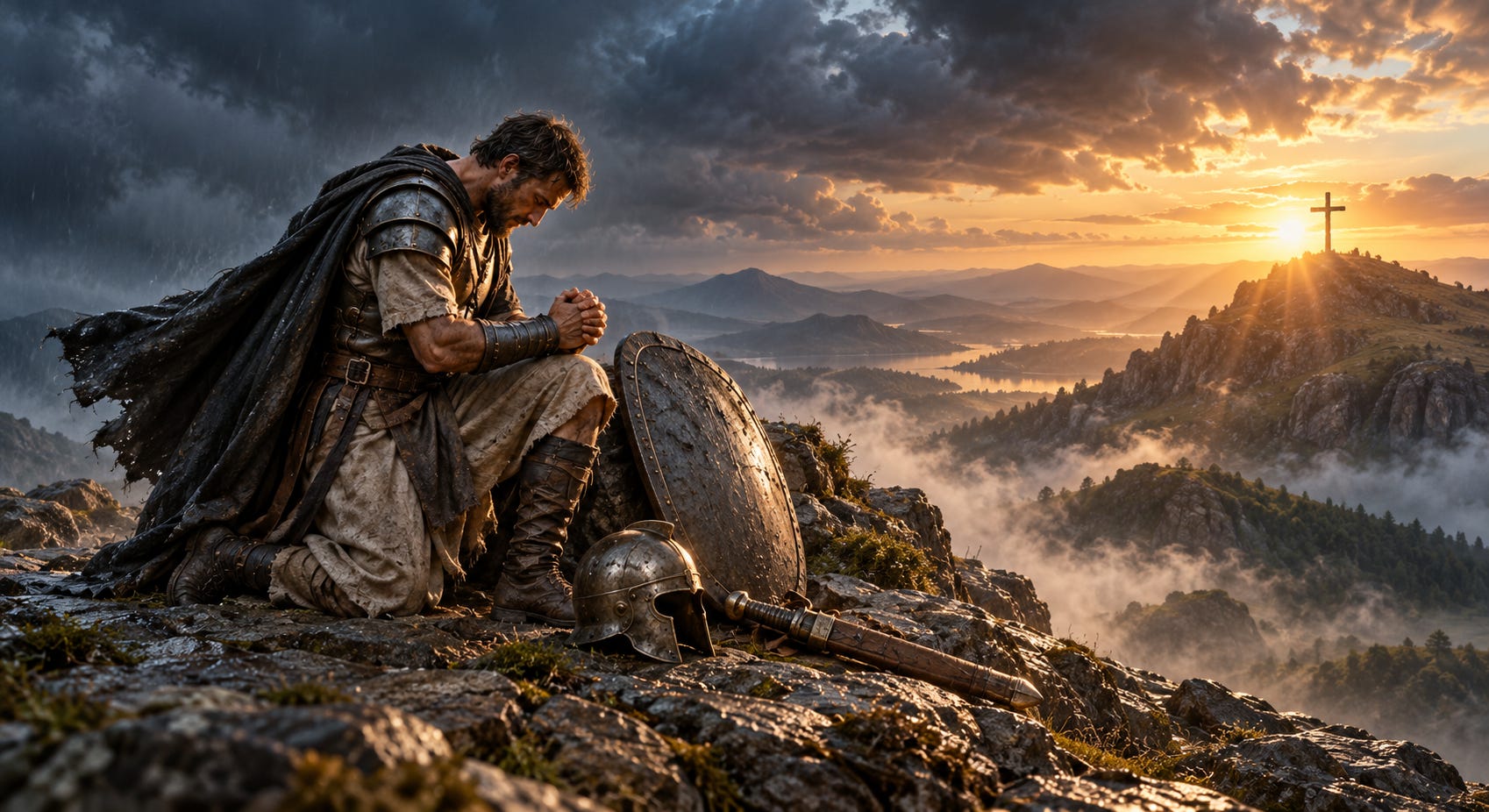
The objection sounds reasonable at first:
If God has already promised that Christ will triumph, Satan will be defeated, evil will be judged, and God’s kingdom will stand forever, then what kind of war are Christians actually fighting?
A battle with a guaranteed ending may appear to be theater. The winner is already known. The final defeat of the enemy has already been declared. Why speak of armor, temptation, resistance, endurance, and spiritual warfare if nothing can change the final result?
Because a settled victory does not make the battle imaginary.
It tells us who will still be standing when the smoke clears.
History contains many battles fought after the final direction of a war had become nearly certain. Soldiers could still be wounded. Towns could still be destroyed. Families could still suffer. Individual choices could still save lives or cost them. A guaranteed national victory did not make every remaining bullet harmless.
The same distinction matters in spiritual warfare.
Christ’s final victory is secure, but temptation still destroys lives. Lies still mislead people. Pride still ruins relationships. Addiction still tightens its grip. Persecution still wounds the faithful. Fear still whispers that obedience is useless, and bitterness still offers injured people a reason to become what hurt them.
Those are not cardboard enemies firing blanks.
The consequences are real.
Scripture does not present Satan as God’s equal. This is not a struggle between two evenly matched powers waiting to discover which one will win. Satan is a created rebel whose reach remains beneath God’s authority. He can tempt, accuse, deceive, and destroy, but he cannot overthrow the throne of God or rewrite the ending God has declared.
A chained enemy can still bite anyone foolish enough to embrace him.
That is why Christians are commanded to remain watchful.
Spiritual warfare is not permission to blame every bad decision upon a demon. Human beings remain responsible for the sins they willingly commit. Neither does it permit us to treat other people as the enemy. Scripture plainly says that our struggle is not against flesh and blood.
People may oppose us, insult us, betray us, or persecute us. We must still remember that they are human beings made in God’s image—not targets to be hated in God’s name.
The enemy works through lies, temptation, accusation, fear, and rebellion. Our weapons therefore cannot be cruelty, manipulation, or revenge. We stand through truth, faith, prayer, righteousness, the gospel of peace, and the Word of God.
That kind of warfare may look unimpressive to a world addicted to noise.
It takes strength to tell the truth when a lie would protect your reputation. It takes strength to forgive without pretending the wound was harmless. It takes strength to resist a temptation no one else would ever discover. It takes strength to pray for an enemy while refusing to join his evil. It takes strength to remain faithful when obedience appears to cost more than compromise.
Those choices matter.
God’s sovereignty does not erase them. It gives them a foundation.
We do not resist evil because we are unsure whether Christ will win. We resist because Christ is Lord, His victory is certain, and our lives belong on the side of truth.
A firefighter does not refuse to enter a burning room merely because the fire will eventually go out. The person trapped inside still matters. The damage done before the flames die still matters. What the firefighter chooses to do still matters.
In the same way, Christ’s future destruction of evil does not make present obedience unnecessary. People are being wounded now. Lies are spreading now. Souls are being tempted now. Mercy can be shown now. Truth can be spoken now.
The final victory belongs to Christ, but our participation remains real.
That does not mean our works purchase salvation. We are saved by grace through faith in Jesus Christ—not by winning enough battles to earn His favor. Every Christian enters the fight as someone already dependent upon mercy.
Faith does not guarantee that we will win every personal struggle without stumbling. Peter denied Christ. David fell into terrible sin. Faithful people can become frightened, exhausted, deceived, or wounded. When we fall, the answer is not to pretend the failure never happened. It is to repent, receive God’s correction, rise through His mercy, and return to the truth.
The war is real enough for failure to hurt.
Grace is real enough for failure not to have the final word.
The three pillars remain standing.
God is sovereign: Satan cannot defeat His purpose, overthrow Christ, or change the ending God has declared.
Human agency is bounded: we make genuine choices inside the conflict, but neither our obedience nor our rebellion can remove God from His throne.
The verdict is settled: Christ will reign, evil will be judged, and every person will finally stand upon the side he chose.
A guaranteed ending does not turn the battlefield into a stage.
It gives the faithful a reason to hold their ground when the night becomes long.
We do not fight to decide whether Christ will be victorious.
We fight because He already is.
“For we wrestle not against flesh and blood, but against principalities, against powers, against the rulers of the darkness of this world, against spiritual wickedness in high places.” —Ephesians 6:12
—Jeff Wager
#WagerEssays #TheEssayDepot #WhatGodSays #Apologetics #Theology