
The objection asks a difficult question: If God already knows the future, declares the end from the beginning, and guarantees His final victory, can any human choice truly be free?
If God knows with absolute certainty what we will do tomorrow, critics argue that we cannot possibly do anything else. The future appears fixed before we reach it. Our choices may feel real, but perhaps we are only acting out a script already written for us.
This objection identifies a genuine mystery, but it treats two different things as though they were the same:
Certainty is not compulsion.
God’s perfect knowledge of a choice does not mean He forced the person to make it. Knowledge tells us what will happen. Causation tells us what made it happen.
Those are not interchangeable.
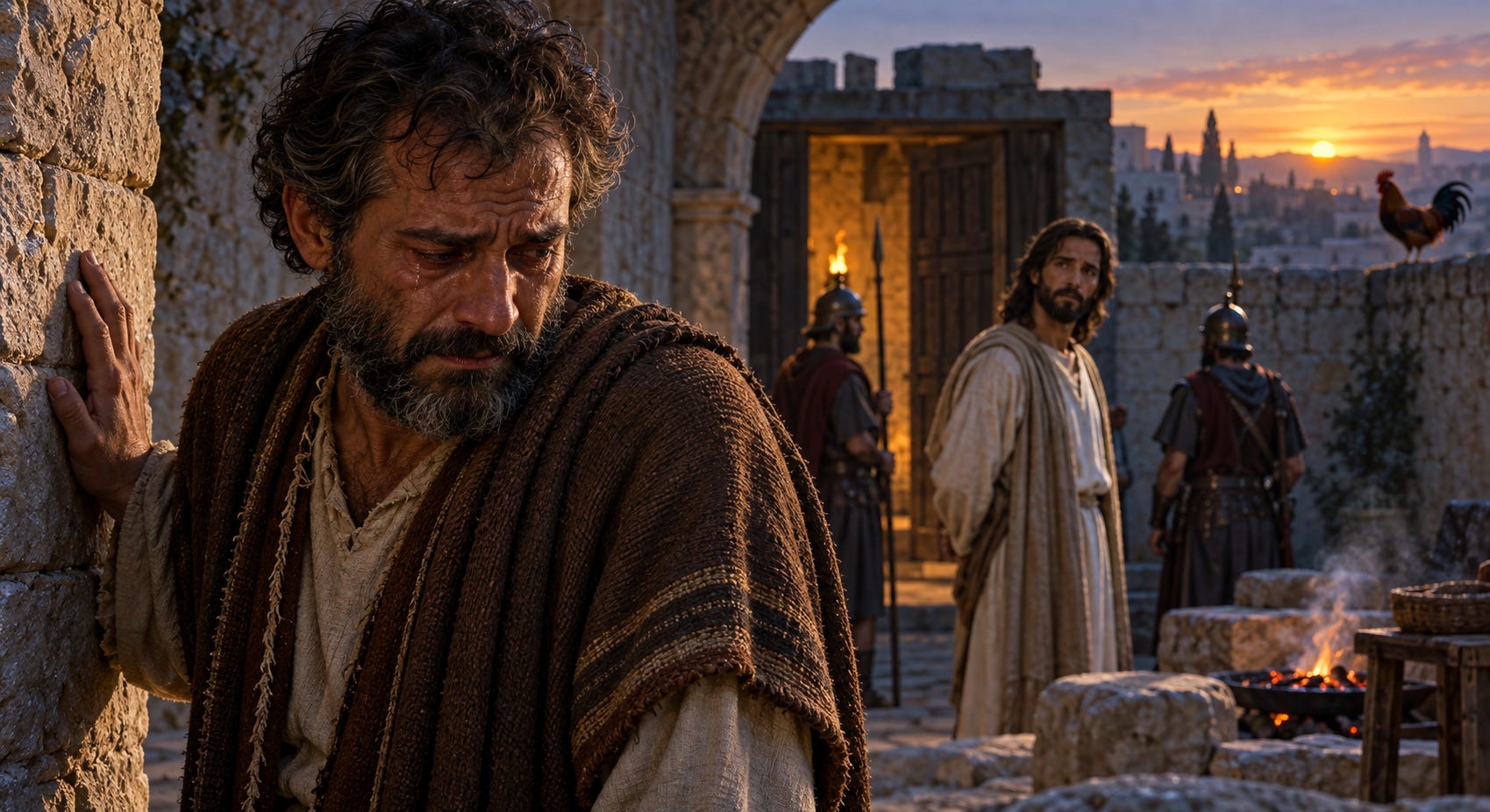
Jesus told Peter that he would deny Him three times before the rooster crowed. The prediction came true exactly as Jesus said. When people identified Peter as one of His followers, Peter denied knowing Him. After the rooster crowed, the Lord turned and looked at Peter. Peter remembered the warning, went outside, and wept bitterly.
Jesus knew.
Peter chose.
The certainty of Christ’s knowledge did not remove Peter’s responsibility for his denials.
Scripture repeatedly places divine certainty and human responsibility beside each other without treating either as false. God knew the crucifixion would occur and used it within His plan of salvation. The people who betrayed and crucified Jesus still acted through their own motives and were held responsible for their deeds.
God’s foreknowledge did not become their excuse.
Neither does prophecy require every moment of history to be a puppet show. God has fixed the final outcome: Christ will reign, evil will be judged, death will be defeated, and God’s kingdom will stand. Human rebellion cannot cancel those promises.
A guaranteed ending does not make every choice along the way meaningless.
A destination can be fixed without every footstep being forced.
We do not need the power to overthrow God’s plan before our daily decisions can matter. Freedom does not require omnipotence. A person can make a real choice without possessing the power to rewrite creation, cancel judgment, or remove God from His throne.
That is the difference between freedom and absolute sovereignty.
God possesses sovereignty.
We possess bounded agency.
Our freedom is real, but it is never equal to His authority.
The rules do not change according to our preference. Truth remains true when we reject it. Sin continues producing death when we rename it. Faith in Jesus continues leading to life when the world mocks it.
Fixed boundaries do not destroy meaningful choice. They make meaningful choice possible. If truth changed every time someone objected to it, no decision could carry lasting weight. We would not live in freedom; we would live in chaos.
The three pillars remain standing.
God is sovereign: He knows the end, guarantees His promises, and cannot be defeated by human rebellion.
Human agency is bounded: our choices are genuine, but they operate inside a reality we did not create and cannot overthrow.
The verdict is settled: God has already declared where faith and rebellion lead, even though each person still chooses which road to take.
We may not understand exactly how God’s perfect knowledge and our choices fit together inside His mind. Scripture does not explain every piece of that mystery.
Mystery is not the same as contradiction.
The Bible does not ask us to choose between a knowledgeable God and responsible human beings. It declares both. God knows perfectly, and people answer for what they willingly do.
The deck is not “fixed” because God secretly forces every hand and then blames the cards.
The outcome is fixed because no creature can defeat the King.
Within that unshakable reality, our choices remain ours, their consequences remain real, and God’s final purpose remains secure.
“Remember the former things of old: for I am God, and there is none else; I am God, and there is none like me, Declaring the end from the beginning, and from ancient times the things that are not yet done, saying, My counsel shall stand, and I will do all my pleasure.” —Isaiah 46:9–10
—Jeff Wager
#WagerEssays #TheEssayDepot #WhatGodSays #Apologetics #Theology