
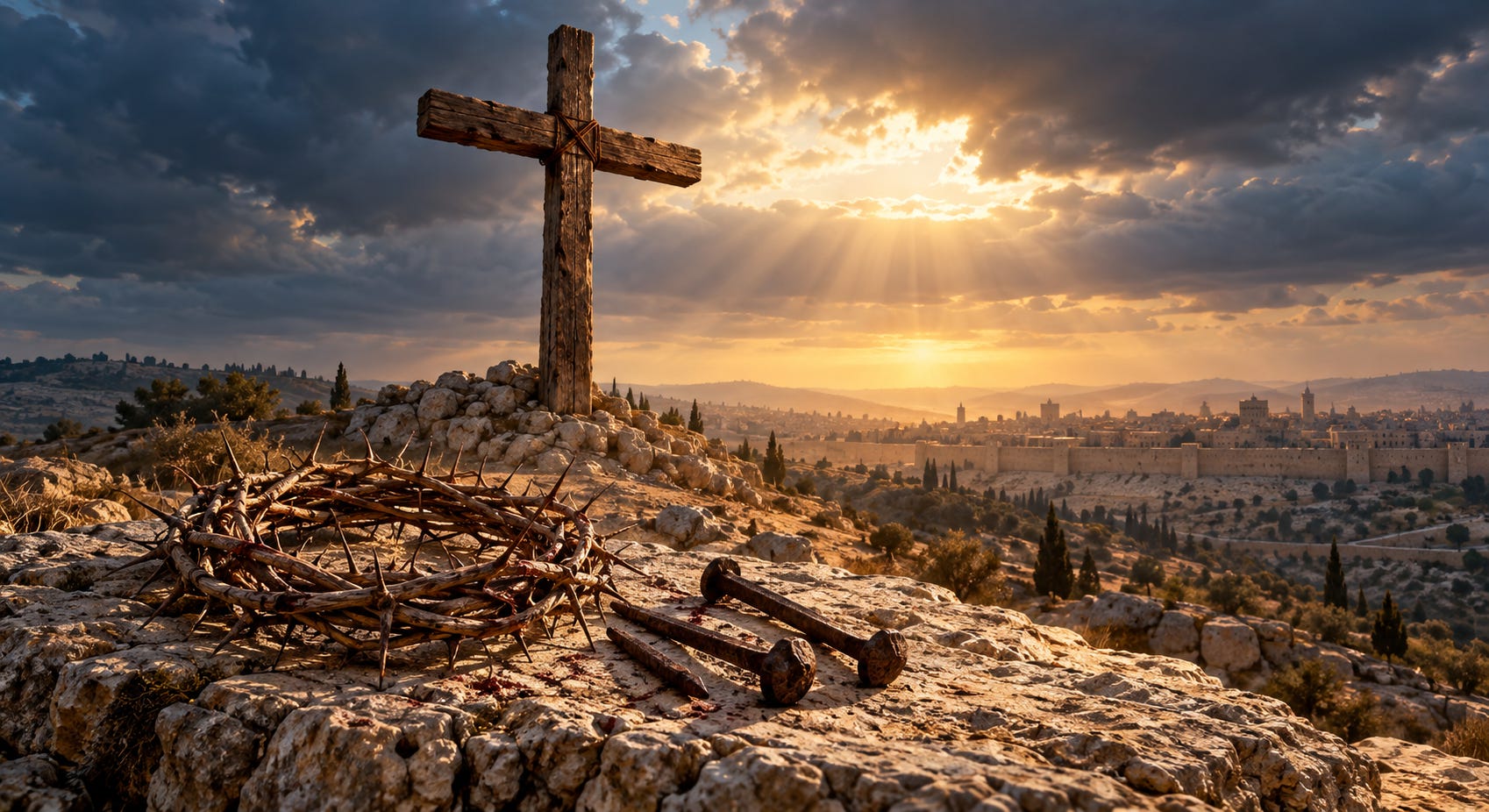
The objection asks why an absolutely sovereign God needed the cross at all.
If God makes the rules, controls the final outcome, and possesses unlimited authority, why could He not simply announce that everyone was forgiven? Why require betrayal, blood, suffering, and death? Was Calvary necessary—or was it a brutal piece of religious theater?
That question reaches the center of Christianity.
The first mistake is treating forgiveness as though it costs nothing. When a debt is forgiven, the debt does not vanish into thin air. The person owed absorbs the loss. When someone breaks a window and the owner forgives him, the glass remains broken. Forgiveness settles who will bear the cost.
Human rebellion is not a bookkeeping error God can erase while pretending no harm occurred. Sin destroys trust, wounds people, corrupts what God created, and separates humanity from the source of life. A righteous God cannot call evil harmless without denying the truth about what evil does.
The cross shows that God does not ignore the cost.
He carries it.
This was not an angry Father punishing an unrelated innocent man. The Father and Son were not enemies standing on opposite sides of Calvary. Scripture says that God was in Christ, reconciling the world unto Himself. Jesus willingly laid down His life. No one took it from Him against His will.
God did not send someone else to pay a price He refused to touch.
He entered our flesh and bore it Himself.
Scripture uses several pictures to explain what happened at the cross. Jesus became the sacrifice for sin. He paid a ransom. He bore our guilt. He reconciled enemies to God. He defeated the powers of sin and death. Each picture shows another side of a work too large to fit inside one comparison.
The cross reveals both justice and mercy.
Justice says evil matters and cannot simply be renamed as good.
Mercy says the guilty do not have to carry the final cost themselves.
At Calvary, God did not weaken His standard to rescue sinners. He met the standard and opened a path home.
Sovereignty does not make the cross redundant. God’s control over the plan does not remove the means through which He chose to accomplish it. A builder’s authority over a house does not make the foundation unnecessary. The foundation is how the house stands.
The cross is the foundation of God’s offer of mercy.
Could human speculation imagine another method? Certainly. People can invent endless ways they think God should have arranged salvation, but Scripture does not tell us what God might have done inside a different universe. It tells us what He did in this one.
Jesus Christ suffered once for sins, the just for the unjust, to bring us to God.
The payment is not earned through human effort. We do not improve ourselves enough to deserve it, and no pile of good deeds can purchase it. Salvation is offered by grace and received through faith in Jesus Christ.
The offer still demands a response.
God does not force people to accept mercy. The same cross that opens the road to life also brings the verdict into clear view. We may trust the One who paid our debt, or reject Him and remain beneath the consequence already declared against sin.
The three pillars meet at Calvary.
God is sovereign: the cross fulfilled His plan rather than repairing an unexpected failure.
Human agency is bounded: people freely committed the evil that crucified Jesus, yet their actions could not prevent God from turning the cross toward salvation.
The verdict is settled: life is offered through faith in Christ, while rejecting Him leaves the sinner responsible for a debt no human effort can pay.
The cross is not an unnecessary decoration added to a mechanical system.
It is where God’s holiness confronted our sin, His mercy absorbed the cost, and death received the wound from which it will never recover.
“For Christ also hath once suffered for sins, the just for the unjust, that he might bring us to God, being put to death in the flesh, but quickened by the Spirit.” —1 Peter 3:18
—Jeff Wager
#WagerEssays #TheEssayDepot #WhatGodSays #Apologetics #Theology