
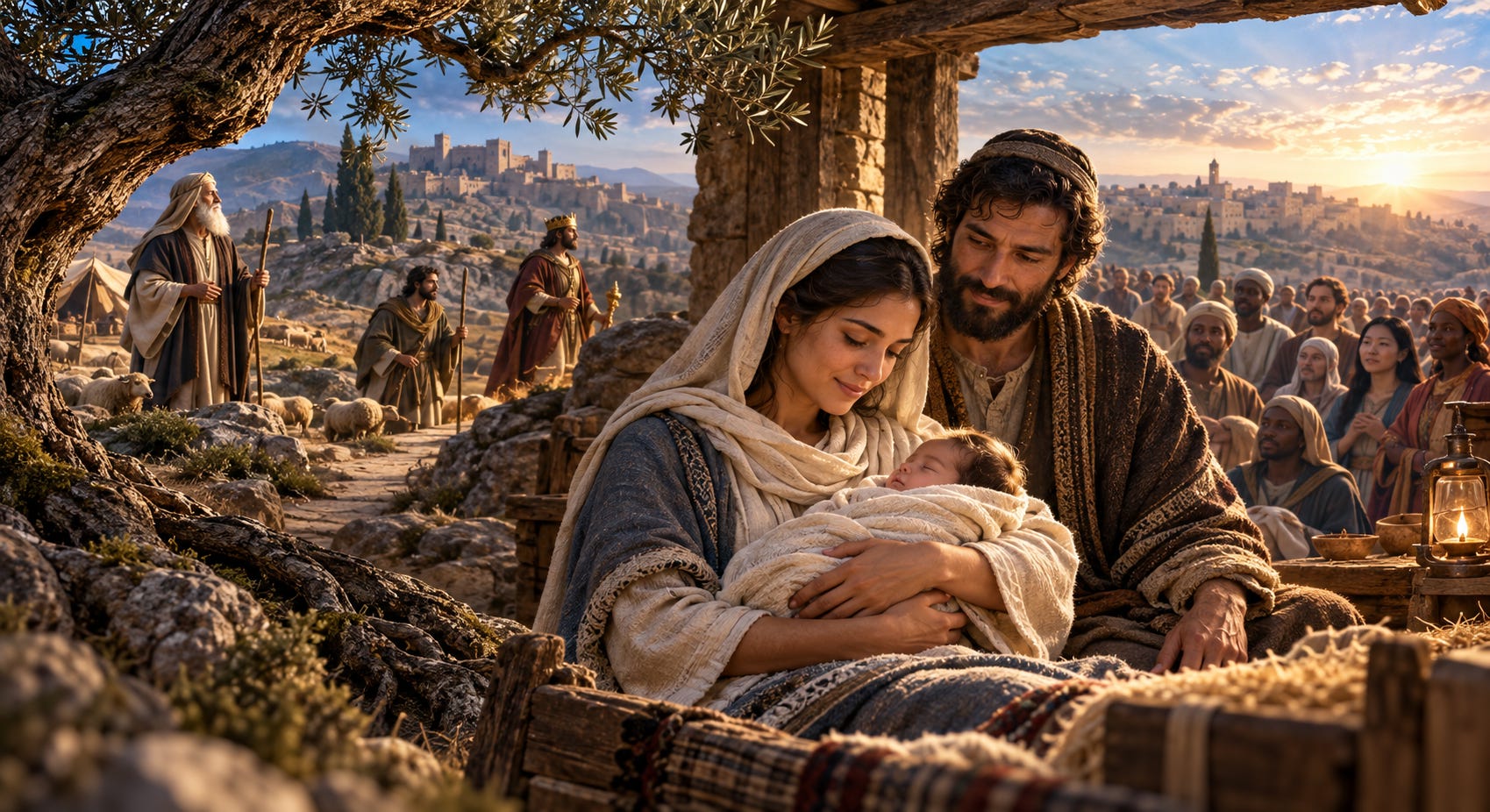
A page full of unfamiliar names can send a reader reaching for the next chapter. Someone begat someone, who begat someone else, whose name looks like it ought to come with pronunciation instructions.
Then we reach Jesus.
Those names were taking us somewhere. They record a real family line through which God brought the promised Savior into the world. The people mattered. Their ancestry mattered. God had made promises concerning particular descendants, and He kept them.
The promise reaches back to Eden, before Israel had a name, before Judah had a tribe, and before David had a throne. God spoke of the woman’s Seed. As Scripture unfolds, the family line comes into clearer view.
Genesis traces Abraham’s ancestry through Noah’s son Shem. Abraham belonged to that larger family, but his descendants formed particular branches within it. Ishmael and Isaac were both his sons. Jacob and Esau were both Isaac’s sons. Being related did not make their places in the promise interchangeable.
God blessed Ishmael and established His covenant with Isaac. The promise continued through Jacob, whom God named Israel.
Before Israel was a nation, Israel was a man.
His twelve sons became the fathers of the tribes. Judah belonged to Israel’s family just as surely as Benjamin, Levi, and the other brothers did. Judah’s descendants were Israelites who also belonged to Judah’s particular tribal line.
A family tree has branches for a reason. Ishmael was related to Jacob, but he was not Jacob’s descendant. Esau was Jacob’s brother, but his family became Edom. Their shared ancestry did not erase those distinctions.
The names we use require the same care. “Semitic” takes its name from Shem, though its main modern use identifies related languages such as Hebrew, Aramaic, and Arabic. When we mean physical ancestry, saying “descended from Shem” tells the reader exactly what we mean.
“Jew” is connected with Judah, but Scripture also uses it more broadly for the Jewish people. Esther identifies Mordecai as both a Jew and a Benjaminite. His broader identity did not erase his particular tribal ancestry.
Jesus’ tribal ancestry is clear. Hebrews identifies Him with Judah. Paul declares Him to be David’s descendant “according to the flesh.” That is physical descent. The Savior entered the human family through a real birth, with real ancestors behind Him.
Matthew opens his Gospel by calling Jesus the son of David and the son of Abraham. His genealogy follows David’s royal line through Solomon to Joseph, Mary’s husband. Luke’s genealogy passes through David’s son Nathan. Both records connect Jesus with David.
Matthew also carefully distinguishes Joseph from the miraculous conception. He identifies Joseph as Mary’s husband, says Jesus was born of her, and explains that she was with child of the Holy Ghost before they came together. Joseph was not Jesus’ biological father.
Jesus was truly born of Mary, and Scripture affirms His physical descent from David. The miracle of His conception did not make His humanity imaginary or His ancestry irrelevant.
God kept His word in human flesh.
The family record also leaves the rough places visible. Judah appears with Tamar. Rahab and Ruth are named. Matthew identifies Solomon’s mother as the woman who had been Uriah’s wife. Even the genealogy refuses to hide the family history.
These people made choices. Some trusted God. Some brought terrible suffering upon others. Their decisions carried consequences, yet none could seize God’s promise and cancel it. His faithfulness carried the line through households, kingdoms, and exile until the promised Savior came.
The family line was specific. The blessing reached beyond it.
God had promised Abraham that all nations would be blessed through his seed. Paul identifies Christ as the fulfillment of that promise and teaches that those who belong to Christ are Abraham’s seed and heirs according to the promise. That inheritance comes through faith.
A person from another nation does not need to invent a place in Judah’s genealogy to receive Christ. Faith does not change someone’s biological ancestors. It brings that person into the blessing God promised through the Savior.
Jesus’ ancestry tells us through whom He came. Faith tells us how we receive Him. Both glorify God. His promise was precise enough to reach a particular family and generous enough to bring blessing to people from every nation.
Nobody earns salvation by producing the right family records. Nobody needs to erase Christ’s family records to explain salvation by grace.
Those difficult names were never empty space between the stories. They carry the record of God’s faithfulness across generations.
The family line leads us to Christ.
Through Christ, the invitation reaches us.
“Concerning his Son Jesus Christ our Lord, which was made of the seed of David according to the flesh; And declared to be the Son of God with power, according to the spirit of holiness, by the resurrection from the dead:” —Romans 1:3–4
—Jeff Wager
#WagerEssays #TheEssayDepot #WhatGodSays #Apologetics #Theology