
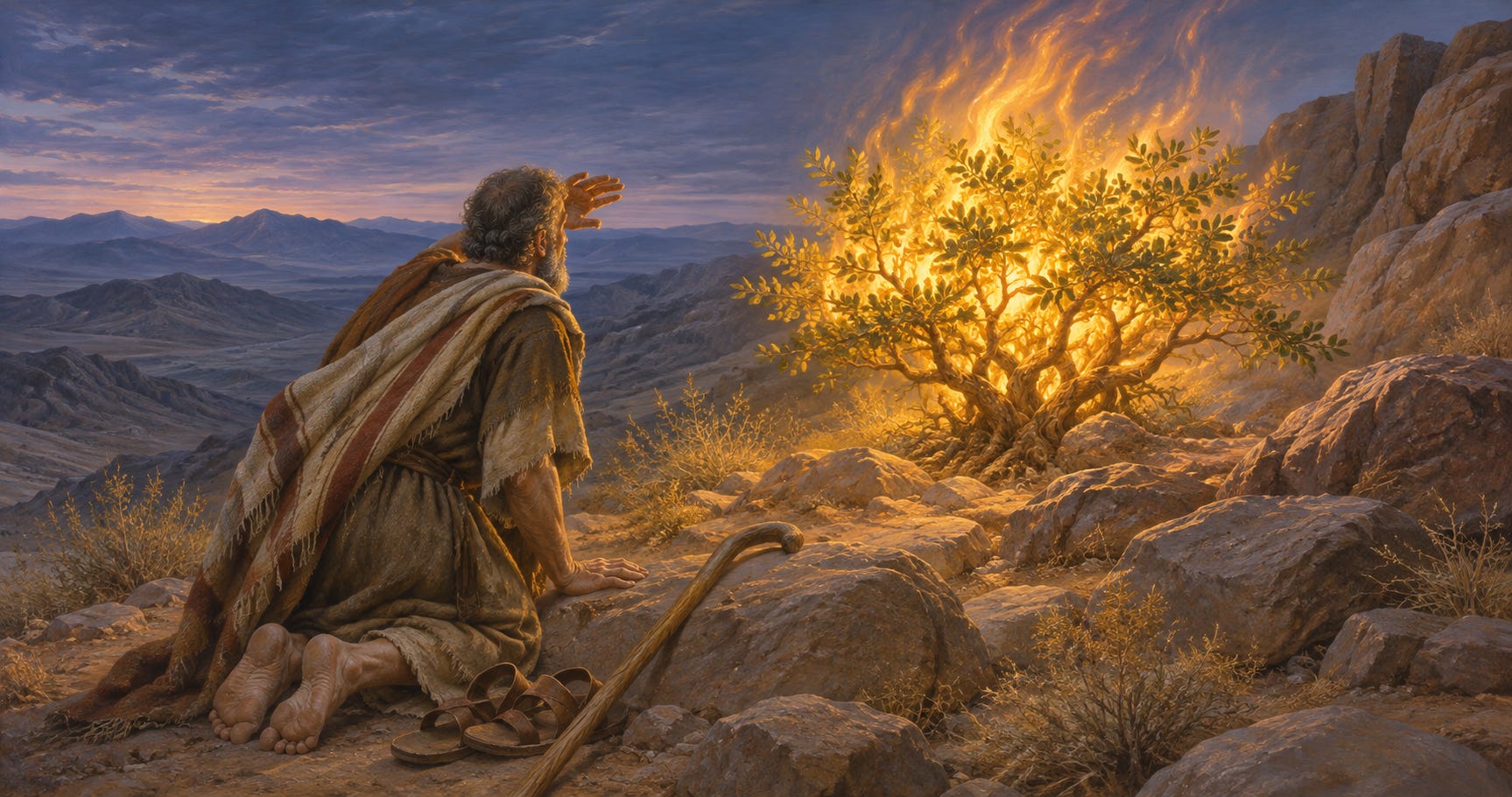
Moses turned aside because the bush would not burn away.
He had been tending his father-in-law’s flock when he noticed the fire. The branches burned without being consumed, and he wanted to see why. Then God called him by name. The shepherd who had approached to examine something unusual was told to stop, remove his shoes, and recognize the ground beneath his feet as holy.
When God identified Himself as the God of Abraham, Isaac, and Jacob, Moses hid his face.
The voice came from the bush, but the knowledge behind it reached far beyond the hillside. God spoke of Israel’s suffering in Egypt. He had seen the oppression, heard the cries, and knew the sorrows of people Moses could not see from where he stood.
God’s attention to the shepherd had not left the slaves unattended.
The bush had become the place of an encounter, not the boundary of God’s presence. He could address Moses there while remaining fully aware of Pharaoh’s taskmasters and the people beneath their hands. Nothing about speaking from one patch of wilderness required Him to stop governing everything beyond it.
Moses questioned his own ability to undertake the task God placed before him. God answered with the promise of His presence. The shepherd would go to Pharaoh, but he would not go alone.
Later, the Lord would lead Israel by cloud and fire. The people could see where He directed them without seeing everything He governed. His care for the company moving through the wilderness did not mean the rest of creation had been left to manage itself.
We divide our attention because we have only so much to give. Listening closely to one person can make us miss another. Being here means we cannot also be standing a thousand miles away. Those are familiar limits, and it is easy to carry them into our thinking about God as though the Maker must live under every condition His creatures experience.
The God of Scripture is not another object inside the universe. He does not owe His existence to its matter, depend upon its passing years to become God, or occupy a place that leaves Him absent everywhere else. Making Himself known within creation does not make creation large enough to contain Him. Our inability to picture how God makes Himself present does not establish a limit on what He can do.
That distinction reaches its greatest wonder in Jesus Christ.
John begins his account before anything was made. The Word was with God, and the Word was God. All things were made through Him. Then the One through whom creation came into existence entered human life.
The Word became flesh and dwelt among us.
This was more than a visible sign or a temporary appearance. The Son truly became human while remaining fully God. He grew in wisdom and stature. He knew hunger, weariness, sorrow, and pain. His humanity was real, and His divine identity had not been exchanged for it.
The One walking a road in Galilee had not ceased to sustain the world beneath His feet.
Scripture holds those truths together. It describes His human growth and speaks of the Son upholding all things by His power. We need not make His human weakness imaginary to preserve His divinity, or make His divinity disappear to account for His weakness. His coming near was an act of divine freedom, not a defeat imposed upon Him by the world He had made.
That becomes especially clear when people demand that He escape suffering to prove who He is.
At His arrest, Jesus told the disciple wielding a sword to put it away. He could appeal to His Father for more than twelve legions of angels. The help was not beyond reach. His question concerned the fulfillment of Scripture and the work He had come to accomplish.
His restraint had a purpose.
At the cross, the mockers treated that restraint as helplessness. They challenged Him to come down if He was the Son of God. The chief priests, scribes, and elders spoke as though His remaining there settled the matter: He had saved others, but could not save Himself.
They had mistaken the rescue He chose not to seek for a rescue He lacked the power to receive.
Their demand would have made escape the test of His identity, while overlooking the sacrifice at the heart of His mission. Jesus was not obliged to abandon the work of redemption to satisfy the terms of their challenge. Their rejection was real, but it did not give them authority over the purpose of His suffering.
His pain and His death were genuine. The divine Son truly suffered and died in His humanity; His divine nature did not cease to exist, and creation did not lose its Sustainer. His resurrection revealed that the cross had not exhausted His authority or brought His mission to ruin.
A wounded body did not establish that He could not be God. Remaining upon the cross did not establish that He was unable to leave it. Those conclusions required assumptions the suffering itself could not supply.
Moses had heard a voice from the bush that knew the cries of Egypt. Centuries later, people beneath a cross heard the voice of the Son and mistook His suffering for the end of His power.
The shepherd’s encounter had not confined God to a hillside. The incarnation had not confined the Son’s divine power to the reach of His human hands.
Those hands were truly wounded. Their wounds belonged to the sacrifice He willingly made for sinners.
The majesty was not missing.
It had come near enough to bear the cost of our redemption.
“And the Word was made flesh, and dwelt among us, (and we beheld his glory, the glory as of the only begotten of the Father,) full of grace and truth.” —John 1:14
—Jeff Wager
#WagerEssays #TheEssayDepot #WhatGodSays #Apologetics #Theology