
Israel arrived at Rephidim with people, children, and cattle to care for.
There was no water to drink.
They had traveled according to the Lord’s command. They had not wandered away on some private expedition. Yet the place where they camped lacked something necessary for life.
The thirst was real. So was the need to do something about it.
The people turned to Moses. “Give us water that we may drink,” they demanded. Moses asked why they quarreled with him and why they tested the Lord.
Their complaint grew into an accusation. Had he brought them out of Egypt to kill them, their children, and their cattle with thirst?
They had gone from needing water to charging their deliverer with leading them toward death.
Moses cried to the Lord. “What shall I do unto this people?” he asked. They were almost ready to stone him.
He could hear the demands. He could not supply what they demanded.
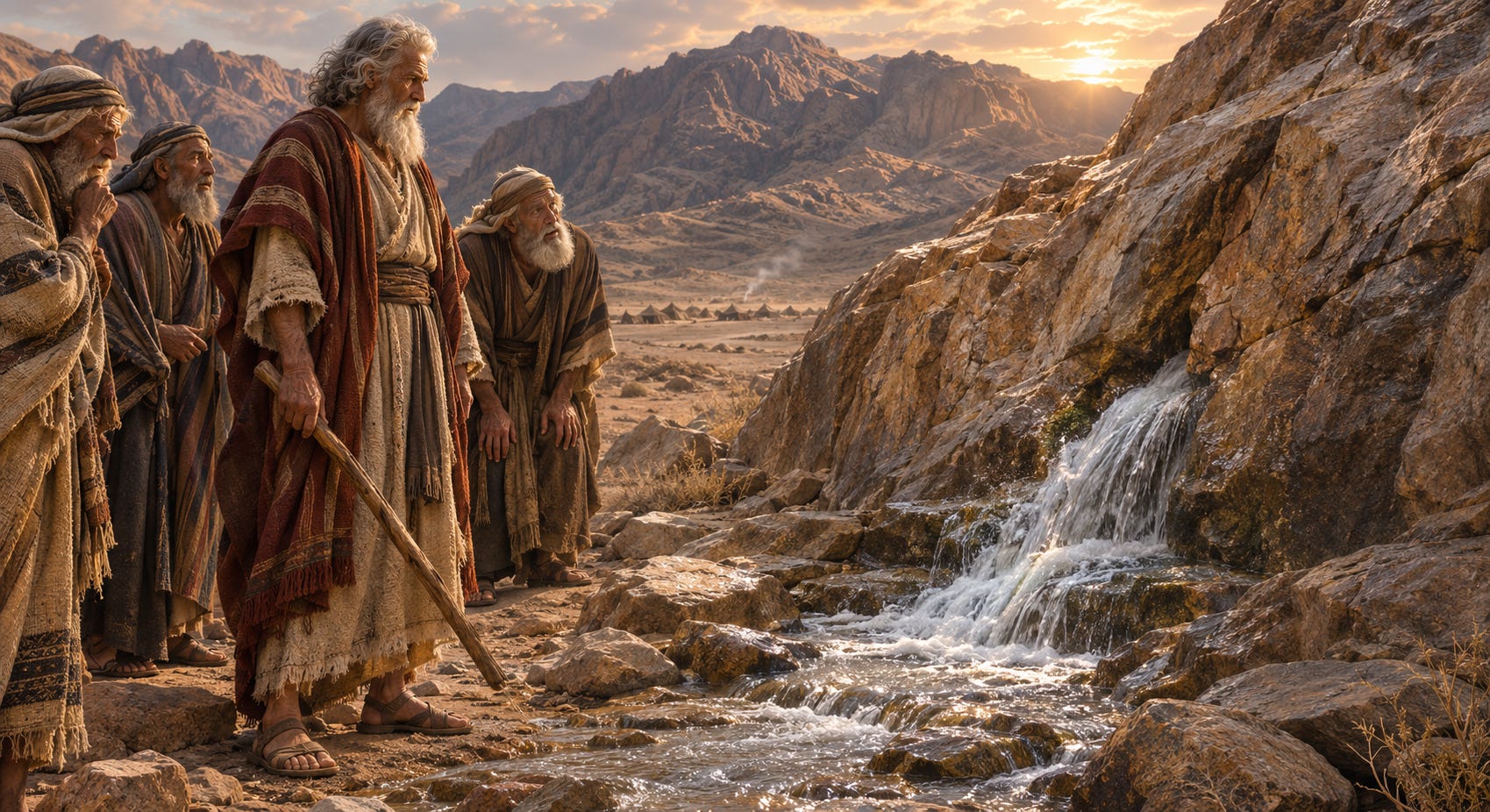
The Lord told Moses to go before the people and take some of Israel’s elders with him. He was to carry the rod with which he had struck the river. God would stand before him upon the rock in Horeb.
Moses was to strike the rock, and water would come out for the people to drink.
He did so in the sight of the elders.
Water came from the rock.
The people received what Moses could never have produced merely because they threatened him. The rod had not become a magic tool. God had given the command and supplied the water.
Their need had reached beyond human ability. It had never reached beyond His.
Moses named the place Massah and Meribah because of their quarreling and their testing of the Lord. Beneath the demand for water stood a question: “Is the LORD among us, or not?”
That was the conclusion their thirst had begun to draw.
They presumed that if God were with them, surely there would be water. There was no water; therefore, perhaps He was not with them.
Their surroundings seemed to settle the matter.
Yet the account begins by telling us they had traveled according to His command. The dry camp did not prove they had escaped His notice. Their difficulty had not removed Him from their story.
We know how quickly a present need can fill our entire view. A bill comes due. An illness continues. Someone we depend upon cannot help. What we lack becomes easier to see than anything God has already done.
The need may be serious. Pretending otherwise helps no one.
The danger comes when we turn that need into a verdict about God: He has forgotten us. He does not care. He must have led us this far only to leave us here.
At Rephidim, the people’s thirst was a fact. Their accusation against God was another matter.
Moses brought the crisis to the One who could answer it. His prayer was urgent and plain. He needed help, and he asked for it.
We can bring our needs that honestly too. Faith does not require us to call thirst comfortable or tell God that nothing is wrong. It gives us reason to turn toward Him with what is wrong.
Horeb records the particular answer He gave that day. We cannot turn it into a promise that every illness will end or every hardship will disappear when we expect it to. We can recognize what the account exposes: our inability to see provision is not proof of God’s absence.
The Israelites had asked whether the Lord was among them.
Before Moses struck the rock, God had already told him where He would stand.
God had been there all along.
“Behold, I will stand before thee there upon the rock in Horeb; and thou shalt smite the rock, and there shall come water out of it, that the people may drink. And Moses did so in the sight of the elders of Israel.” —Exodus 17:6
—Jeff Wager
#WagerEssays #TheEssayDepot #WhatGodSays #Apologetics #Theology