
By noon, Baal’s prophets had been calling for hours, and Elijah had a suggestion: perhaps their god needed waking. They had prepared their sacrifice, appealed to Baal, and leaped about the altar without receiving an answer. Elijah suggested they cry louder. Perhaps their god was occupied, traveling, or asleep.
The sarcasm had teeth. A god who needed his worshippers to wake him was hardly ready to rescue them. The prophets increased their cries and cut themselves until blood flowed, yet no answer came. All that effort could not supply the power their god lacked.
When Elijah prayed, he asked that the people would know the Lord was God and that He was turning their hearts back to Him. God answered by fire, and the people fell on their faces, declaring that the Lord was God. Hours of shouting had brought no answer from Baal; the Lord had answered His servant’s prayer.
Scripture can tell a story with an edge sharp enough to cut through a very impressive costume.
Consider Eglon, the Moabite king whom Israel had served for eighteen years. When the people cried to the Lord, God raised up Ehud as a deliverer. Carrying a concealed dagger, Ehud eventually gained a private audience with the king, struck him with his left hand, and left the chamber with its doors shut and locked behind him.
The servants found the doors locked and assumed Eglon was relieving himself. They waited while Ehud escaped. Eventually, their waiting became embarrassing, so they took a key, opened the doors, and discovered their lord dead on the floor.
A king who had held a nation in service lay beyond a locked door while his servants waited for him to finish a bathroom visit. His power had reached its limit, and they did not yet know it. By the time they opened the chamber, the man God had raised to deliver Israel had slipped beyond their reach.
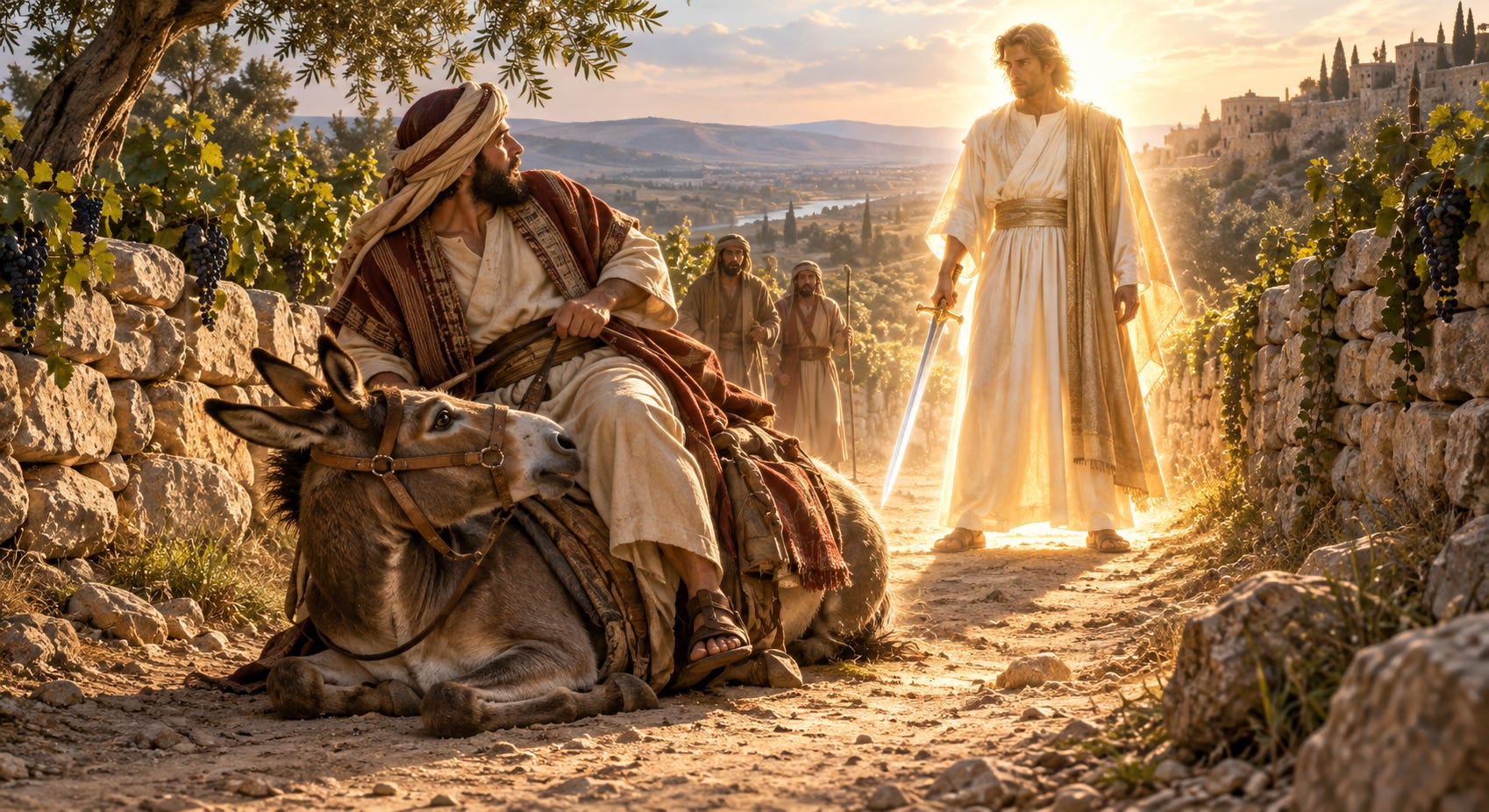
Balaam encountered a different interruption on the road to Moab. His donkey saw the Angel of the Lord standing ahead with a drawn sword and turned into a field. Balaam, who saw no angel, struck her to force her back onto the road. Later, between vineyard walls, she pressed against a wall and crushed his foot. He struck her again.
At a narrower place, with no room to turn aside, the donkey lay down beneath him. Balaam’s anger rose, and he beat her with his staff. Then the Lord opened her mouth, and she asked what she had done to deserve those three beatings.
Balaam answered that she had mocked him. He wished he had a sword so he could kill her.
There was already a sword on that road.
The danger he could not see was the reason his donkey had refused to continue. She reminded him of her faithful service and asked whether she had ever behaved this way before. He admitted she had not. Then God opened his eyes, and he saw the angel standing with the drawn sword.
Balaam bowed his head and fell on his face. The angel asked why he had struck the donkey and told him that his way was perverse. Had she not turned aside, Balaam would have been killed and the donkey spared.
The creature he had been beating had helped keep him alive.
“I have sinned,” Balaam admitted. He offered to turn back, but the angel permitted him to continue with a restriction: he was to speak only the word God gave him. The rider who had been forcing his way forward now had instructions to obey.
Balaam needed his eyes opened. The donkey had already seen enough to stop.
“The Lord shall laugh at him: for he seeth that his day is coming.” —Psalm 37:13
—Jeff Wager
#WagerEssays #TheEssayDepot #WhatGodSays #Apologetics #Theology