
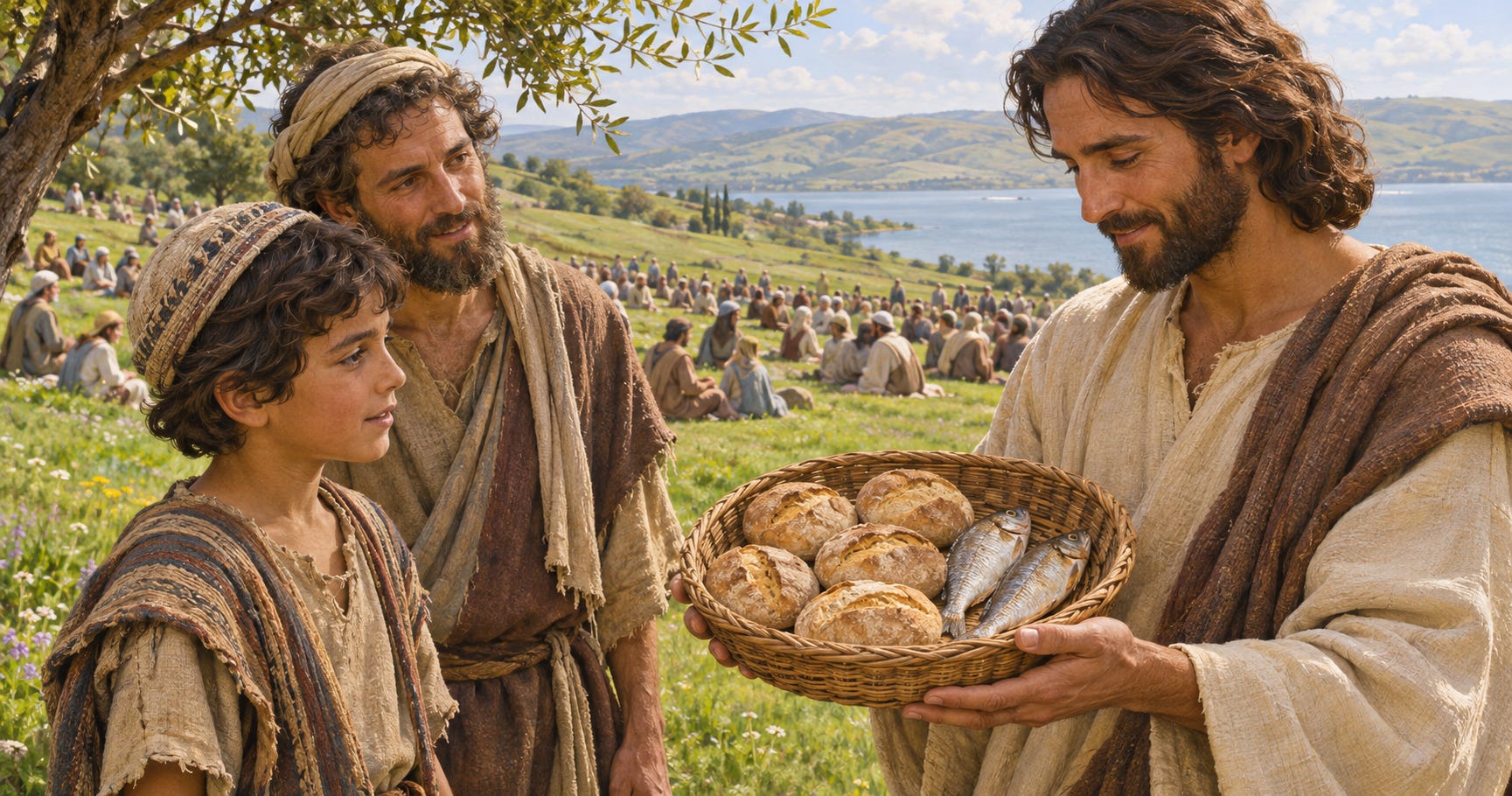
Five barley loaves and two small fish were somewhere in that great crowd, in the possession of a boy whose name John never gives us. Around him were thousands of people who had followed Jesus across the Sea of Galilee. Up on the hillside, Jesus looked toward the approaching multitude and asked Philip where they could buy enough bread to feed them.
Philip considered the expense. Two hundred pennyworth would not buy enough for everyone to receive even a little. His answer measured the size of the problem honestly. There were too many people for the money to stretch.
Jesus had asked the question knowing what He would do. Philip was calculating a provision that Jesus had already settled.
Andrew brought another possibility into the conversation. There was a boy with five barley loaves and two small fish. Andrew mentioned the food, then asked the question that made the discovery seem hardly worth announcing: what was that among so many?
It was a fair question. Five loaves remained five loaves, whether five people needed them or five thousand. Counting the crowd again would not make the bread go farther. Everything the disciples could see told them how little they had.
Jesus told them to have the people sit down.
There was plenty of grass, and about five thousand men settled upon it. Before the disciples had seen enough food, they had received an instruction. They began arranging the people for a meal they could not yet explain.
The boy’s bread was now in Jesus’ hands.
John leaves the boy’s thoughts unrecorded. He gives us no speech about surrender, no promise the child made, no account of what he expected in return. The food and the boy are there in the telling, and then our attention follows the loaves into the hands of Christ.
Jesus gave thanks.
The bread went out to the seated crowd, along with the fish. People received as much as they wanted. The meal that Andrew could scarcely imagine serving became a meal from which thousands ate their fill.
Philip had considered whether a large sum could buy everyone a little. Jesus fed them until they had enough.
Then He sent the disciples to gather what remained, allowing nothing to be wasted. They collected twelve baskets of fragments from those five barley loaves. The shortage they had discussed was followed by a surplus they carried.
The people recognized something extraordinary. They spoke of the prophet who was to come into the world. Their excitement soon reached beyond receiving what Jesus had given: they intended to take Him by force and make Him king.
Jesus withdrew alone into the mountain.
The hands that had supplied their bread were not theirs to command. Their hunger had not exceeded His power, and their enthusiasm did not determine His purpose.
The next day, when people came looking for Him, Jesus addressed what had brought them back. They had eaten and been filled. He directed them toward food that endures to everlasting life, which the Son of man would give them.
They asked what they should do to perform the works of God. His answer brought the matter to faith in the One God had sent.
The conversation had moved from what they could eat to whom they would believe.
Jesus identified Himself as the bread of life. He spoke of everlasting life for those who believe in Him and promised to raise them up at the last day. The crowd had wanted to decide what sort of king He would be. He was telling them what He had come to give.
The unnamed boy’s five loaves had been enough in His hands to feed the multitude. The multitude’s appetite, however, could not define the measure of His gift. He had satisfied their hunger for an afternoon and was offering life beyond the grave.
They had come looking for bread.
The Bread of Life was speaking to them.
“I am the bread of life: he that cometh to me shall never hunger; and he that believeth on me shall never thirst.” —John 6:35
—Jeff Wager
#WagerEssays #TheEssayDepot #WhatGodSays #Apologetics #Theology