
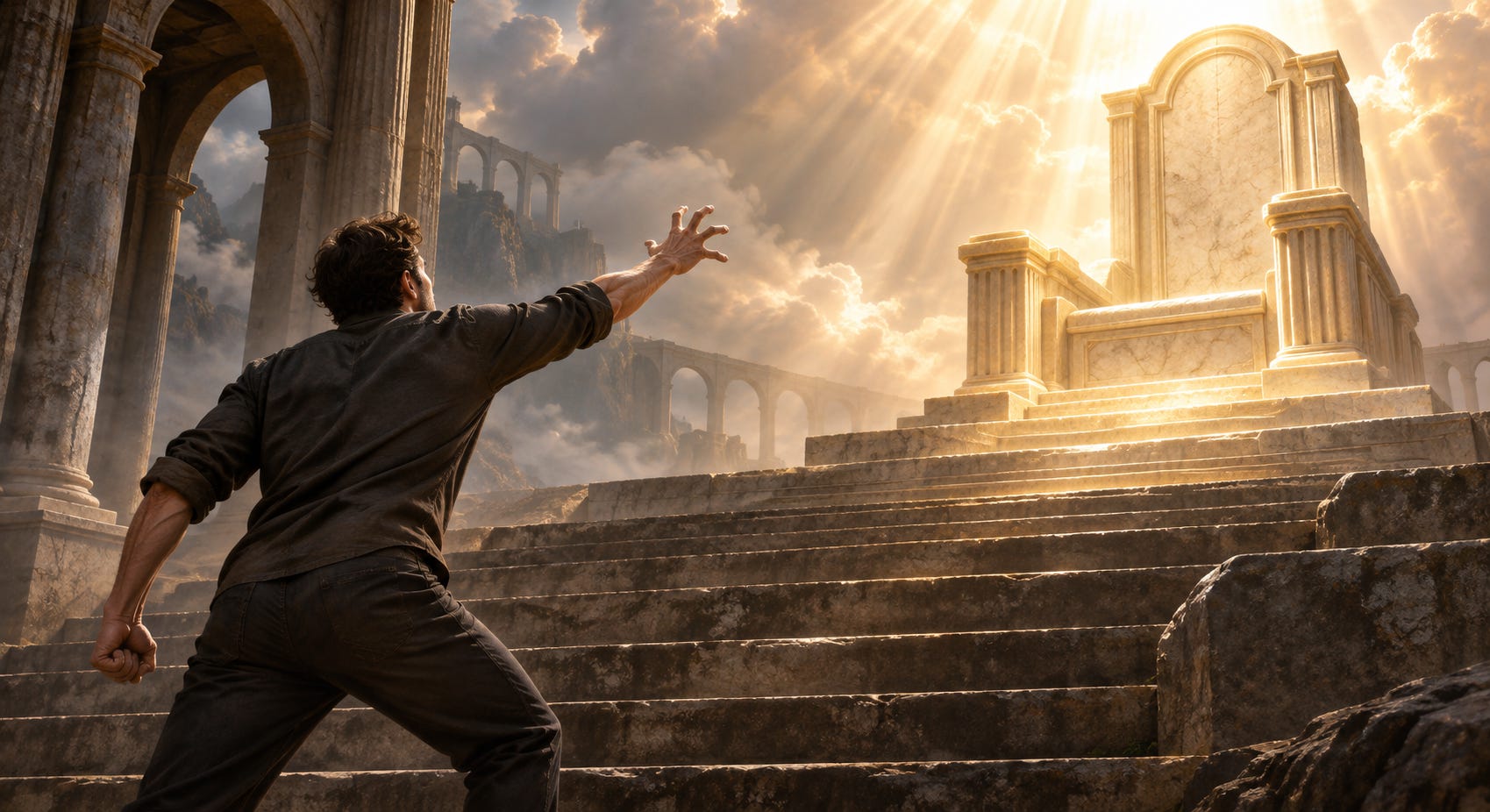
“I did not choose the world I was born into. I did not establish its rules. I cannot decide what consequences follow my actions. How, then, can anyone say I have free will?”
The argument sounds as though something has been withheld. Before we accept that conclusion, we should ask what would satisfy the complaint.
The freedom to make a choice is already there. What is missing is the power to establish the conditions and command the outcome.
That is the demand to be a god unto yourself.
We should put that plainly, because the argument hides its demand inside a different question. It asks whether we are free while requiring something far greater than freedom: authority over the reality in which we live.
Consider the complaint about consequences. A person wants to choose a behavior but objects to what God has declared will follow it. He wants a different result attached to the same act. If he cannot arrange that, he calls his freedom an illusion.
What he wants is to choose the act and overrule God.
We recognize the problem when someone else claims that authority. A dishonest man cannot make his lie trustworthy by deciding that dishonesty should produce the benefits of truth. A cruel man cannot declare his conduct harmless while his neighbor carries the injury. Giving himself permission does not change what he has done.
Yet that is precisely the authority being demanded when freedom means making our choices answer only to rules we approve.
We do not need to govern the entire universe to make that demand. We can claim a smaller kingdom: ourselves.
“I only want to decide what is right for me.”
Does that include deciding whether the person you hurt was really harmed? Does it include requiring God to approve what He forbids? Where does your private authority stop when your decisions reach another person’s life?
A god unto himself soon expects everyone else to live with his decrees.
The garden brings the issue into focus.
God gave Adam a command concerning the tree of the knowledge of good and evil. He also declared the consequence of disobedience: death. Adam had not created the garden, established the command, or determined what eating the fruit would bring.
He still had a choice.
The serpent challenged God’s words. He denied the announced consequence and offered a desirable outcome instead: their eyes would be opened, and they would be as gods, knowing good and evil.
The temptation offered more than forbidden fruit. It invited them to distrust God’s authority and reach for what He had withheld. Did they also think, “I am not truly free unless I can establish my own circumstances and consequences—unless I can be a god unto myself”?
They ate.
Their eyes opened, but God’s warning still stood. Their choice had not transferred His authority into their hands. They could disobey His command. They could not command Him to make disobedience end differently.
That is the difference between exercising freedom and claiming the throne.
Our circumstances do influence us. Our bodies have limits. Our upbringing shapes expectations, and suffering can make obedience difficult. God knows those things completely. Recognizing responsibility does not require pretending everyone has the same abilities or faces the same struggle.
None of that gives us authority to make our wishes the final law.
God gave us freedom within His creation. We can obey or rebel, tell the truth or defend a lie, receive His mercy or reject it. Those choices matter because His authority and the consequences He declares remain real.
We have all made choices we cannot undo. The answer to that guilt is the mercy God provides through Jesus Christ, who died and rose again. Salvation is His gift, received through faith. We cannot invent another Savior or require Him to accept terms of our own.
We can come honestly, with our failures known, and trust the One who offers forgiveness.
The choice is ours. The throne is His.
If we refuse to call that freedom because we cannot occupy His throne, the complaint has finally shown its face.
We are demanding to be gods unto ourselves.
“I call heaven and earth to record this day against you, that I have set before you life and death, blessing and cursing: therefore choose life, that both thou and thy seed may live:” —Deuteronomy 30:19
—Jeff Wager
#WagerEssays #TheEssayDepot #WhatGodSays #Apologetics #Theology