
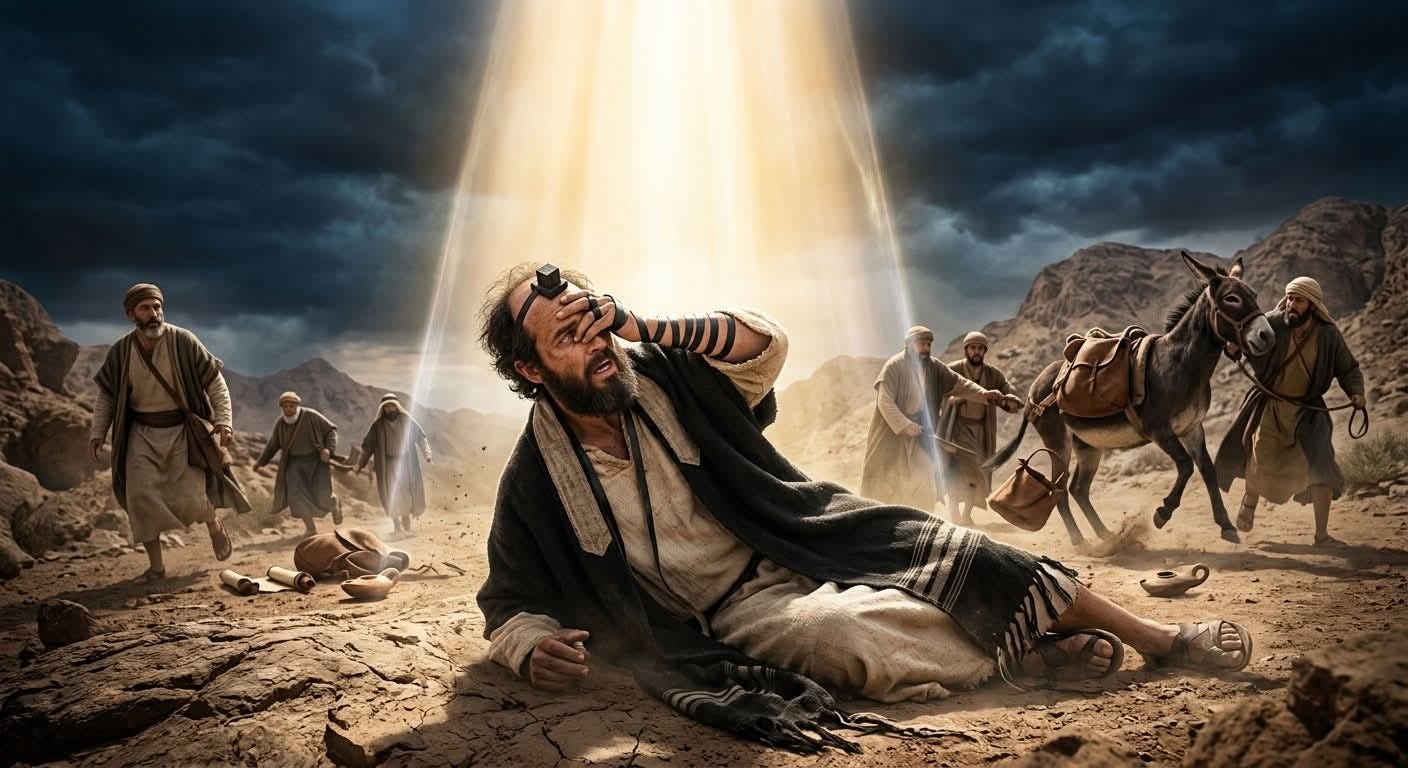
Saul was traveling to Damascus with permission to bring people back in chains. He had obtained letters from the high priest to the synagogues there. If he found followers of the Way, whether men or women, he could take them bound to Jerusalem.
He had authority behind him, a destination ahead of him, and every intention of carrying out his mission.
Saul believed he was serving God. Years later, he would describe his zeal and the persecution it had driven him to pursue. His devotion was fierce, but the people suffering under it belonged to the very Lord he thought he honored.
Near Damascus, a light from heaven shone around him. It was midday, yet Saul would later describe that light as brighter than the sun. He fell to the earth and heard a voice.
“Saul, Saul, why persecutest thou me?”
“Who art thou, Lord?” he asked.
“I am Jesus whom thou persecutest.”
The name Saul had come to silence was speaking to him from heaven.
His letters had authorized him to seize the followers of Jesus. They could give him no authority over Jesus Himself. The men and women he hunted were known to the risen Lord, who called Saul’s persecution of them persecution of Himself.
Trembling and astonished, Saul asked, “Lord, what wilt thou have me to do?”
Jesus told him to rise and enter the city, where he would be told what he must do. When Saul stood and opened his eyes, he could not see. His companions took him by the hand and led him into Damascus.
He had intended to enter the city taking charge of others. He arrived needing someone to guide his next step.
For three days he remained without sight, neither eating nor drinking. The Lord told a disciple named Ananias where to find him and added, “Behold, he prayeth.”
Ananias knew Saul’s reputation. He had heard how much harm this man had done to the believers in Jerusalem, and he knew Saul had authority to arrest those who called upon the Lord’s name. Going to him meant approaching the very man the disciples had reason to fear.
The Lord had work for Saul beyond the mission that had brought him there. He told Ananias that Saul was a chosen vessel to carry His name before Gentiles, kings, and the people of Israel. He would also suffer for that name.
Ananias went to the house, laid his hands upon Saul, and called him “Brother Saul.” Jesus had sent him so Saul could receive his sight and be filled with the Holy Ghost. Something like scales fell from Saul’s eyes. He could see again, arose, and was baptized. After eating, he regained his strength.
Soon he was in the synagogues proclaiming that Jesus is the Son of God. The people who heard him were amazed. This was the man who had come to arrest those who called upon that name.
His energy now served the truth he had fought.
Saul’s story gives us reason to examine what our confidence rests upon. Sincerity can drive a person a long way in the wrong direction. Religious approval can travel with him. Neither makes his actions right before God.
Christ confronted Saul with the truth, and Saul answered by asking what the Lord would have him do. Years later, he would tell King Agrippa, “I was not disobedient unto the heavenly vision.” The man who had been directing the pursuit was now following the One he had opposed.
His earlier choices had caused real suffering. Mercy did not turn that harm into something good or make his persecution innocent. It gave a guilty man a new direction under the authority he had resisted.
Like Saul, when we blindly follow leaders who deny the divinity of Jesus, we fall; but when we hear the voice of God and see the Light of Truth, we rise.
We proclaim to the world, “Jesus is the Son of God.”
“And as he journeyed, he came near Damascus: and suddenly there shined round about him a light from heaven: And he fell to the earth, and heard a voice saying unto him, Saul, Saul, why persecutest thou me?” —Acts 9:3–4
—Jeff Wager
#WagerEssays #TheEssayDepot #WhatGodSays #Apologetics #Theology