
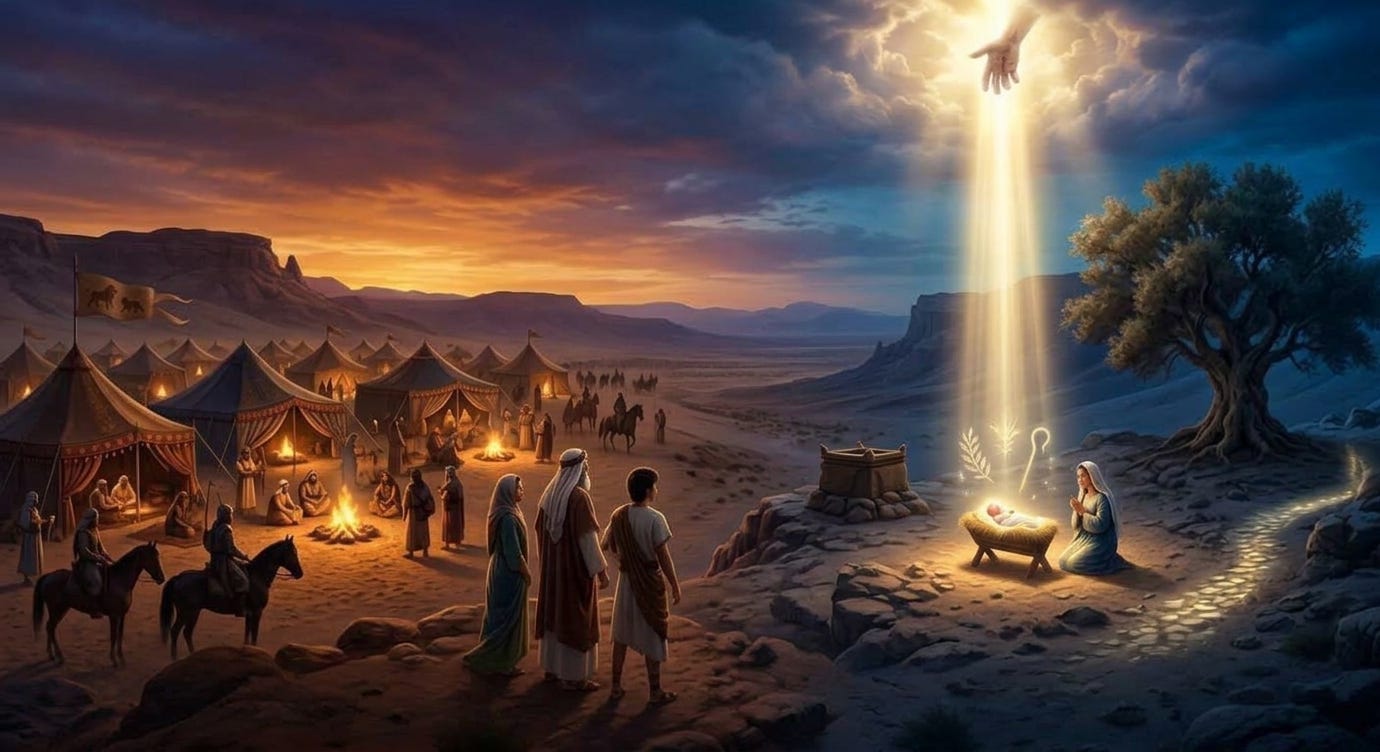
By every human calculation, Ishmael appeared to be the obvious heir.
He was Abraham’s firstborn son, already thirteen years old when God spoke in Genesis 17. Isaac had not even been conceived. Sarah was past childbearing age, and Abraham was ninety-nine. If the family had been voting, Ishmael would have won before Isaac’s name ever made it onto the ballot.
Abraham seemed to think so too.
When God promised that Sarah would bear a son, Abraham replied, “O that Ishmael might live before thee!” His request was understandable. Ishmael was not an idea or an argument. He was Abraham’s son, and Abraham loved him.
God did not scold Abraham for loving the boy, nor did He throw Ishmael into the desert and forget him. He promised to bless Ishmael, make him fruitful, multiply his descendants, raise twelve princes from his line, and make him a great nation.
God did not change the covenant.
The promised line would pass through Isaac.
That is the divine plot twist. Human custom pointed toward the firstborn. Age pointed toward Ishmael. Biology laughed at Sarah. The family tree had already grown a branch, but God announced that the covenant fruit would grow from a branch no one could yet see.
God did not ask human tradition which son He was allowed to choose.
Isaac received the covenant before he had drawn a breath, performed a good deed, or proved himself worthy. The choice rested entirely upon God’s promise. Ishmael received a tremendous blessing, but Isaac carried the particular covenant line through which Israel would come and, generations later, Jesus Christ would enter the world.
Abraham and Sarah had made their own plans when they turned to Hagar. Their choice was real, and its consequences were real. Their decision could not climb onto God’s throne, steal His pen, and rewrite what He had already promised.
That is the line human pride keeps tripping over.
We may act, choose, build, hurry, and produce something that looks close enough to God’s plan to fool ourselves. We may even present it to Him and ask Him to sign the bottom. God is not obligated to crown our substitute merely because we worked hard producing it.
His promise does not bend around our impatience.
God cared for Ishmael, blessed him, and gave him a future. He kept the covenant with Isaac exactly as He had determined. Human choices brought consequences into the family, but they never overthrew the sovereignty of God.
The promised son came when human strength had run out, human timing had expired, and human wisdom had nothing left to offer. That was the point. Isaac’s birth would not display Abraham’s cleverness. It would display God’s faithfulness.
Through that impossible birth, God kept the line moving toward another promised Son—the One through whom every nation may be blessed.
“And God said, Sarah thy wife shall bear thee a son indeed; and thou shalt call his name Isaac: and I will establish my covenant with him for an everlasting covenant, and with his seed after him.” —Genesis 17:19
—Jeff Wager
#WagerEssays #TheEssayDepot #WhatGodSays #Apologetics #Theology