
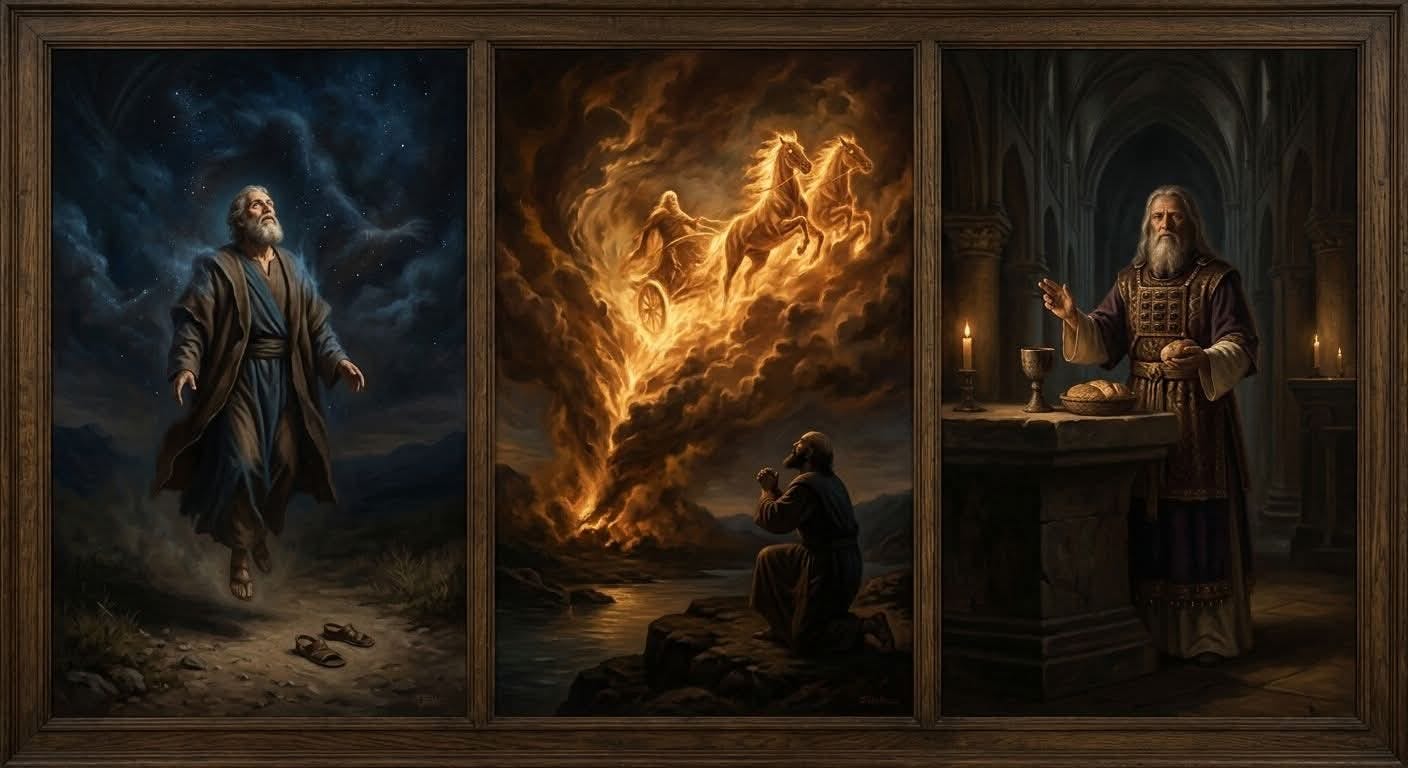
Death keeps an impressive ledger. Kings, servants, warriors, and prophets have all watched their names entered upon its pages. Human strength may postpone the appointment, but it has never possessed the authority to cancel it.
God does.
Genesis 5 moves with the steady beat of a funeral march. One generation follows another. Each man lives, fathers children, reaches his appointed number of years—and dies. The pattern repeats until the reader can almost hear the grave closing after every name.
Then Enoch breaks the rhythm.
He lived among generations drifting farther into corruption, yet he chose to walk with God. Scripture does not describe a single heroic moment that earned him an escape. It describes a life: three hundred years of continued fellowship and faithfulness.
Then his entry ends without a funeral.
Enoch “was not; for God took him.” Hebrews makes the meaning unmistakable: he was translated so that he should not see death. The grave did not lose track of him. God removed him from its reach.
Centuries later, Elijah approached the same boundary by a far louder road.
The prophet had confronted kings, challenged false prophets, called down fire, fled through the wilderness, and learned that God’s voice was not limited to wind, earthquake, or flame. When the time came for Elijah to leave, he walked beside Elisha toward the Jordan.
Everyone seemed to know that something tremendous was coming.
Elijah crossed the river after striking it with his mantle. Elisha stayed beside him, refusing every opportunity to turn back. While the two continued walking and talking, a chariot of fire and horses of fire divided them. Elijah rose into heaven by a whirlwind while Elisha watched from below.
Enoch’s departure fills a few words. Elijah’s fills the sky with motion.
The manner differed, but the authority did not. Neither man conquered death through his own strength. Neither discovered a secret passage into heaven. God determined the boundary, God chose the hour, and God carried out His will.
Melchizedek enters this account differently.
He appears suddenly in Genesis as king of Salem and priest of the most high God. He blesses Abraham, receives a tenth of the spoil, and then vanishes from the historical account as abruptly as he entered it. Genesis supplies no genealogy, records no beginning of his priesthood, and closes no account of his death.
Hebrews takes that silence and turns it toward Christ.
Melchizedek is presented as king of righteousness and king of peace, “made like unto the Son of God.” His recorded priesthood is not bound to the ancestry later required of Israel’s priests. He stands within Scripture as the likeness of another Priest whose authority would not pass from father to son and whose ministry could never be ended by death.
Melchizedek was the likeness. Christ is the fulfillment.
Enoch demonstrated that God can take a man before death. Elijah demonstrated that God can lift a man beyond the ordinary course of death. Melchizedek’s recorded priesthood pointed toward the One who would enter death, defeat it, and rise with an endless life.
Three men stand against the long shadow of the grave, but the glory belongs to God alone.
Human beings still choose whether they will walk with Him, serve Him, or turn away. Death remains beyond our power to defeat; it is not sovereign. It keeps no one whom God commands to rise, and it possesses no authority beyond what the eternal King permits.
Enoch was not found. Elijah left his mantle behind. Melchizedek left a silence shaped like an everlasting priesthood.
All three direct the eye toward Jesus Christ—the Priest whom death could not dismiss, the King whom the grave could not hold, and the Lord before whom death itself must answer.
“Who is made, not after the law of a carnal commandment, but after the power of an endless life.” —Hebrews 7:16
—Jeff Wager
#WagerEssays #TheEssayDepot #WhatGodSays #Apologetics #Theology