
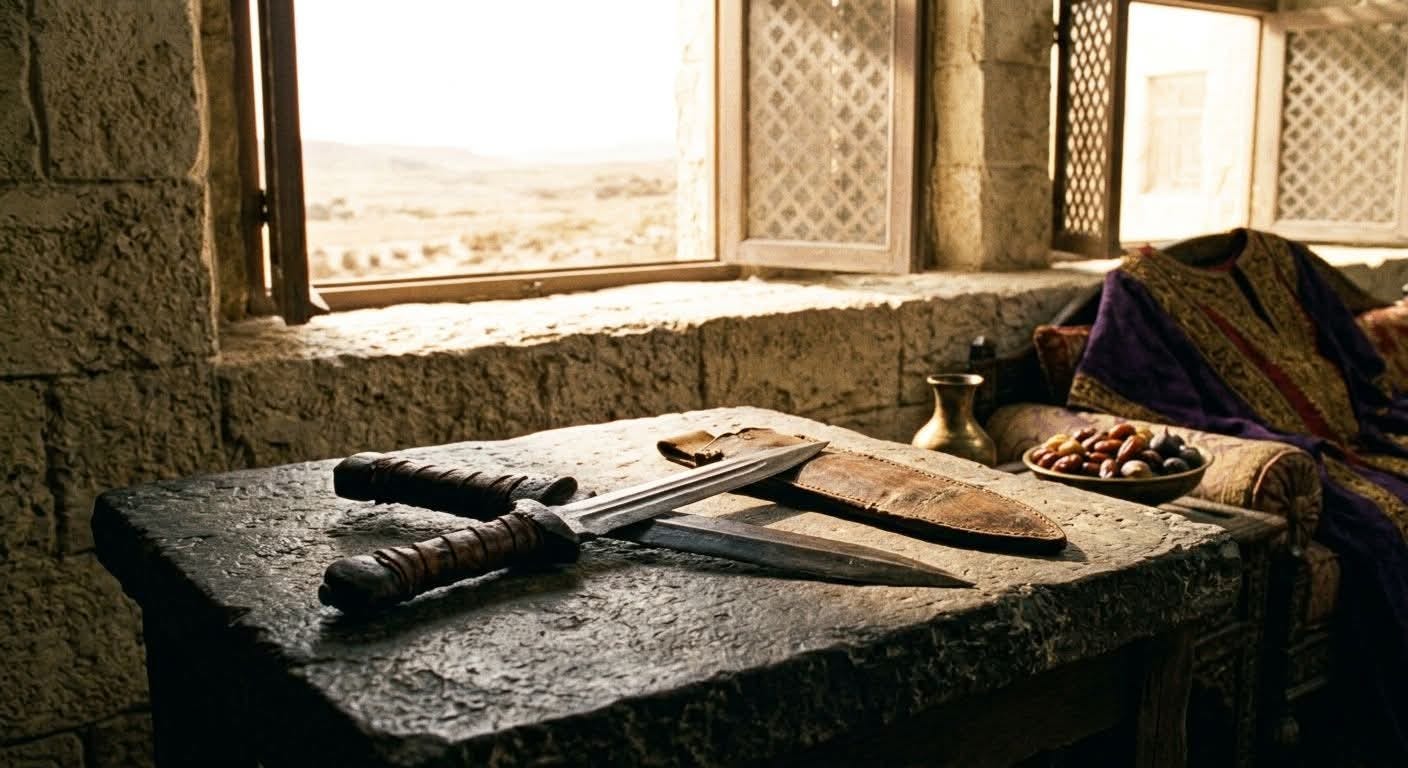
Israel had wandered from God again. The people chose evil, and their choice came with consequences. God strengthened Eglon, king of Moab, against them. Eglon joined forces with Ammon and Amalek, defeated Israel, and took possession of the city of palm trees.
Israel served him for eighteen years.
Eglon collected their tribute while Israel lived beneath his rule. The people finally cried unto the Lord. God heard them, but He did not send an army dressed for a parade. He raised up Ehud, a left-handed man from the tribe of Benjamin.
The detail appears small until the story begins to turn.
Ehud made himself a double-edged dagger about a cubit long and fastened it beneath his clothing against his right thigh. Scripture does not tell us whether anyone searched him. It simply tells us where he hid the blade and which hand he would use.
Ehud carried Israel’s tribute to Eglon. After presenting it, he sent away the men who had carried it. He then turned back from the quarries near Gilgal and returned to the king.
“I have a secret errand unto thee, O king,” he said.
Eglon called for silence, and everyone attending him went out.
That was the first twist of the blade, though the dagger had not yet been drawn. The promise of a private message had cleared the room. The men who might have protected the king were outside.
Ehud approached him in the cool upper chamber.
“I have a message from God unto thee,” he said.
Eglon rose from his seat.
Ehud reached across with his left hand, drew the dagger from his right thigh, and drove it into the king. The blade disappeared beneath Eglon’s flesh, and Ehud left it there. The ruler who had taken Israel’s tribute for eighteen years had just received a payment of his own.
Eglon wanted a secret message.
He got one.
It came with a point.
Ehud escaped through the porch, shut the chamber doors behind him, and locked them. When Eglon’s servants returned, they found the doors bolted. They assumed the king was relieving himself and waited outside rather than disturb him.
They waited.
Then they waited long enough to become embarrassed.
By the time they finally took a key and opened the doors, Eglon was dead and Ehud was gone. The locked chamber had sheltered Israel’s deliverer’s escape. Eglon’s privacy became Ehud’s head start.
No throne is tall enough to rise beyond God’s reach. No locked door can keep His judgment outside. Eglon made choices. Israel made choices. Ehud made choices. Every person acted willingly, yet none of them ever stepped beyond the authority of God.
Ehud escaped to the hill country of Ephraim and sounded a trumpet. Israel gathered behind him, seized the crossings of the Jordan, and cut off Moab’s retreat. About ten thousand Moabite warriors fell, and not one escaped.
Moab was subdued, and the land rested for eighty years.
Ehud was an unlikely deliverer carrying an unexpected weapon in an unexpected place. God did not need the kind of man a royal court would have chosen. He chose the man He had already prepared.
That truth reaches far beyond Eglon’s chamber. Human power still likes locked rooms, guarded doors, impressive titles, and the comfortable belief that tomorrow belongs to whoever controls today. God can overturn all of it with one overlooked person, one hidden instrument, and one perfectly timed turn.
Ehud brought Israel eighty years of rest. Every earthly deliverance eventually fades, which is why mankind needed a greater Deliverer. Jesus Christ did not merely break the rule of one earthly king. He entered death itself, shattered its claim, and opened the way to everlasting life.
Eglon’s chamber reminds us that evil may sit comfortably for a season, but it never sits securely. God sees the throne, the locked door, and the secret deeds committed behind it.
When His appointed hour arrives, judgment does not knock.
“So Moab was subdued that day under the hand of Israel. And the land had rest fourscore years.” —Judges 3:30
—Jeff Wager
#WagerEssays #TheEssayDepot #WhatGodSays #Apologetics #Theology