
Jesus Christ was already at work long before anyone laid Him in a manger.
Think about that little child in Bethlehem. Mary held Him in her arms, yet the world she stood upon had been made through Him. His human life began with His conception in Mary’s womb; His divine existence had no beginning.
John opens his Gospel there. Before the shepherds, before Abraham, before the first sunrise, the Word was with God, and the Word was God. Then the Word became flesh and dwelt among us.
The One who entered our history had been there all along.
Look back through the Old Testament, and you find encounters that make a person stop and pay attention.
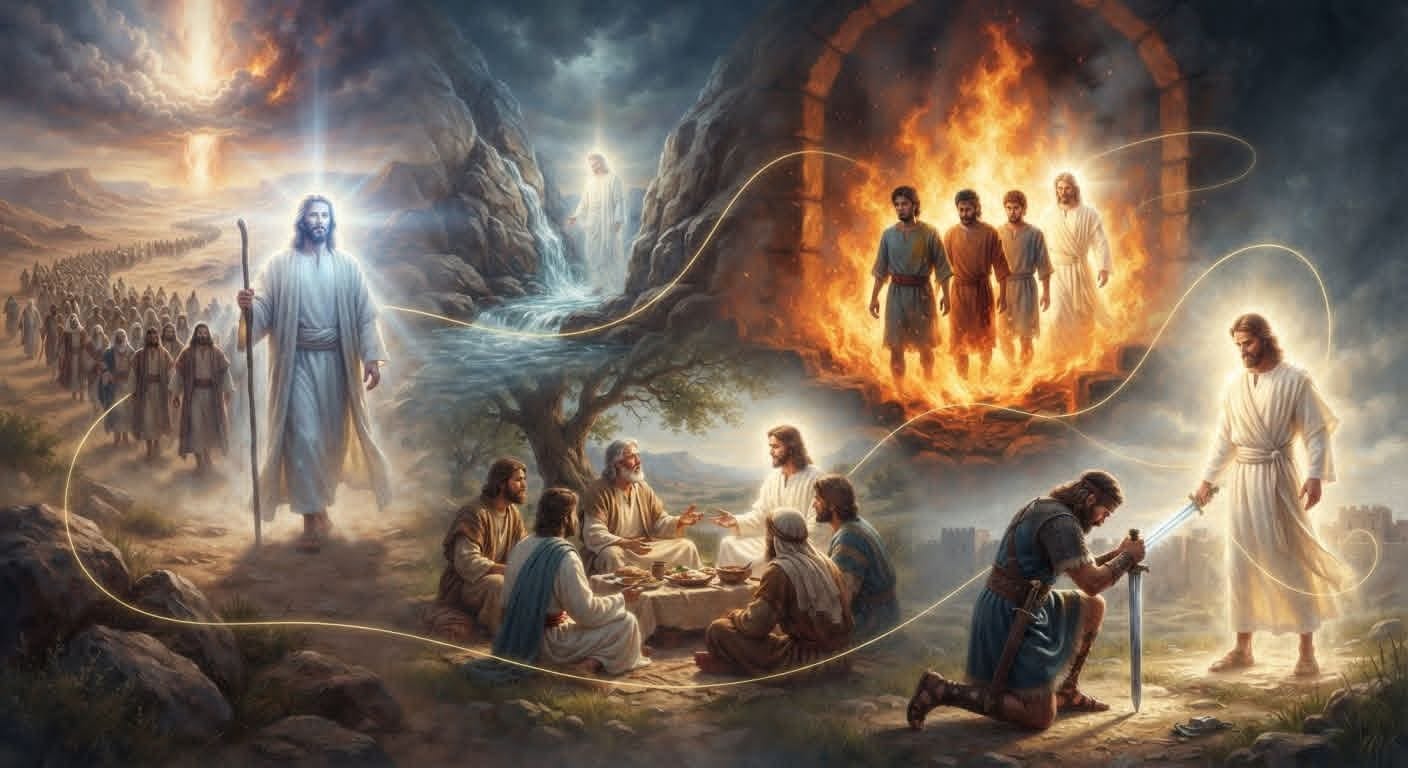
At Mamre, the Lord appeared to Abraham. Three men stood nearby, and Abraham hurried to welcome them. He arranged a meal and stood beneath the tree while they ate. During that visit came the promise that Sarah would bear a son.
Sarah laughed within herself.
The Lord heard that, too.
“Is any thing too hard for the LORD?” —Genesis 18:14
Years later, Moses saw a bush burning without being consumed. Exodus says the Angel of the Lord appeared in the flame, then tells us that God called to Moses from the bush. Moses was told to remove his shoes. He was standing on holy ground.
The God who spoke knew His people’s suffering in Egypt. He had heard their cries. Moses would go to Pharaoh, and God would bring His people out.
Before Jericho fell, Joshua encountered a man holding a drawn sword. Joshua approached with a soldier’s question: Was this man on Israel’s side or the enemy’s?
The answer introduced someone who outranked him—the captain of the Lord’s host.
Joshua fell on his face and worshipped. He asked what his Lord would say to His servant. Then came a familiar instruction: remove his shoe, because the ground was holy.
Joshua had gone forward asking whose side the stranger was on. He ended up listening for orders.
Many Christians understand these encounters as appearances of the eternal Son before He came in the flesh. That understanding grows from the way these passages describe God’s presence and authority. We should tell them carefully, allowing Scripture to speak without supplying names it does not explicitly give.
The furnace in Daniel deserves that same care.
Three men were thrown into the fire. Nebuchadnezzar saw four walking unharmed. He later praised God for sending His angel to deliver the servants who trusted Him.
Christians have long recognized Christ in that fourth figure. Daniel records the deliverance without naming the figure Jesus. The wonder remains: the king could order those men into the furnace, but he could not make the flames obey him.
When Paul looks back at Israel in the wilderness, he names Christ directly. He writes that the people drank from the spiritual Rock that followed them, “and that Rock was Christ” (1 Corinthians 10:4).
Their Deliverer was already at work.
That same passage remembers people who received God’s provision and still turned against Him. His presence called for trust and obedience. Their choices carried consequences.
The story continued toward Bethlehem and the cross according to God’s purpose. Peter tells us that Christ was foreordained before the foundation of the world. Redemption was settled in God’s purpose before humanity ever needed rescuing.
The Savior knew the road He had come to walk.
After His resurrection, Jesus walked with two discouraged travelers and explained the things concerning Himself throughout the Scriptures, beginning with Moses and the prophets.
Imagine hearing Him tell that story.
They had watched Him die and thought their hope was buried. The risen Christ was walking beside them, opening the very Scriptures that had prepared them for His coming.
Those ancient pages belong to His story. The promises lead to Him. The salvation they anticipated is fulfilled in Him.
The One we trust today was there before Abraham ever drew a breath.
“Jesus said unto them, Verily, verily, I say unto you, Before Abraham was, I am.” —John 8:58
—Jeff Wager
#WagerEssays #TheEssayDepot #WhatGodSays #Apologetics #Theology