
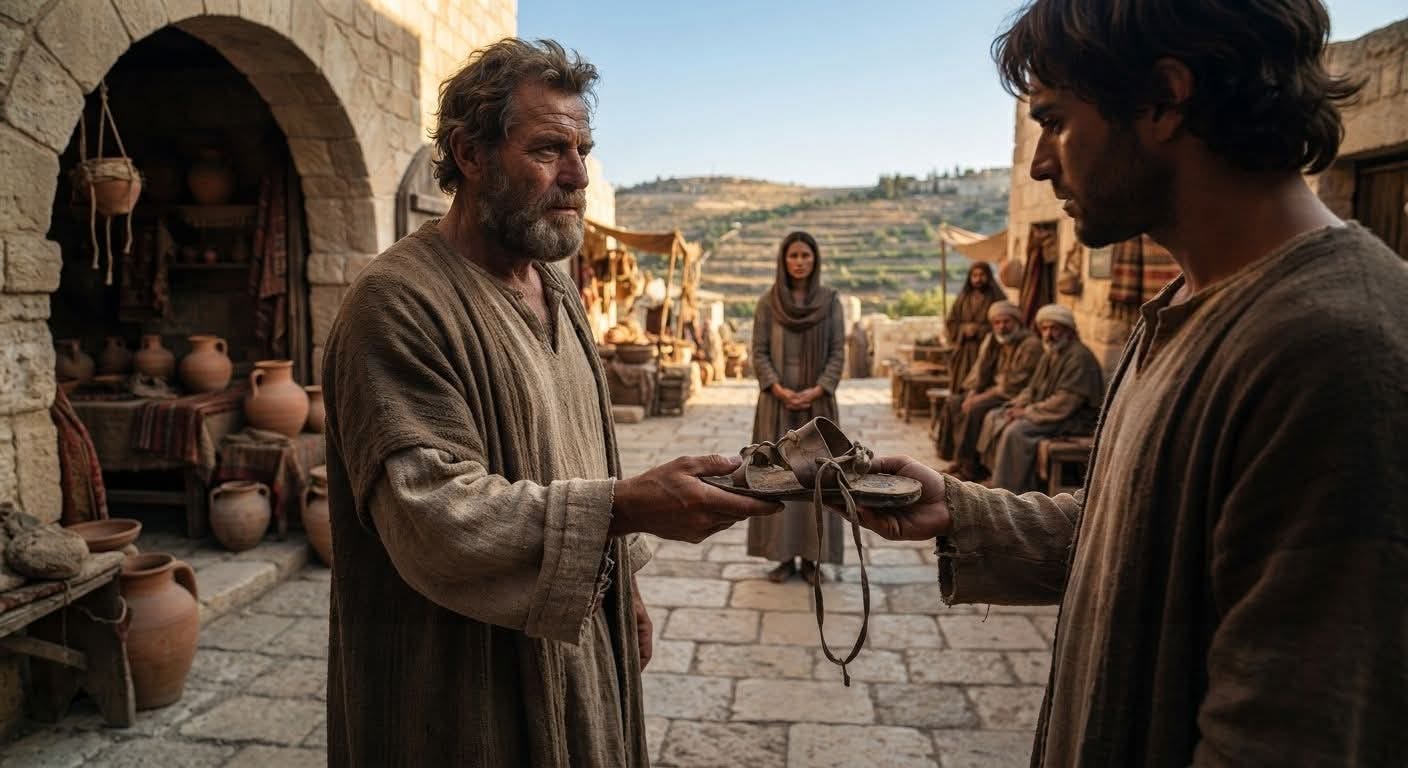
Bethlehem’s city gate was more than an entrance. It was where elders gathered, disputes were settled, and agreements became public record. Boaz went there with purpose. Ruth had asked him to act as her kinsman-redeemer, but one man stood closer in the family line and held the first right to redeem.
Boaz sat down, called the man aside when he passed, and gathered ten elders to witness what followed. He explained that Naomi was selling the property that had belonged to Elimelech. The nearer kinsman agreed to redeem it.
Then Boaz mentioned Ruth.
Redeeming the property also meant accepting responsibility for Ruth and preserving the name of her deceased husband through the inheritance. Suddenly, the bargain looked different. The man feared that doing so would damage his own estate, so he surrendered his right to Boaz.
The confirmation came with a gesture.
He removed his sandal.
In Israel at that time, the sandal confirmed the transfer of redemption rights. Before the elders and everyone gathered at the gate, one ordinary shoe carried the force of a legal declaration: I release my claim. The right and responsibility now belong to you.
Boaz did not hesitate. He publicly declared that he had acquired the property of Elimelech, Chilion, and Mahlon from Naomi. He also declared that he would take Ruth as his wife so that Mahlon’s name would remain connected to his inheritance. The witnesses answered, “We are witnesses,” and blessed Ruth and Boaz before the Lord.
The transaction at the gate settled the matter, but God was carrying the story much farther than anyone standing there could see.
Ruth became Boaz’s wife, and the Lord gave them a son named Obed. Obed became the father of Jesse, and Jesse became the father of David. Generations later, Matthew recorded that same family line as it continued to Jesus Christ.
The unnamed kinsman made his choice because he feared for his inheritance. Boaz made his choice knowing redemption would cost him. Scripture leaves one man unnamed, while the other became part of the lineage of Israel’s greatest king—and ultimately the earthly line of the Messiah.
A sandal changed hands at a dusty gate in Bethlehem. The witnesses saw a legal transfer. God saw the next step toward a manger.
“Now this was the manner in former time in Israel concerning redeeming and concerning changing, for to confirm all things; a man plucked off his shoe, and gave it to his neighbour: and this was a testimony in Israel.” —Ruth 4:7
—Jeff Wager
#WagerEssays #TheEssayDepot #WhatGodSays #Apologetics #Theology